
Several years ago, I attended a conference marking the 300th anniversary of the birth of Jonathan Edwards. Since that time I have acquired several helpful volumes on Edwards’ life and thought, as well as several volumes of his sermons and writings.
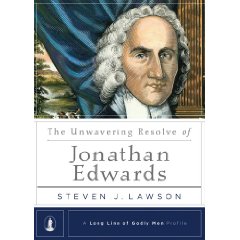
This book, The Unwavering Resolve of Jonathan Edwards, is my latest foray into Edwards. Part of a new biographical series by Steve Lawson (his first was The Expository Genuius of John Calvin), this book is not a biography in the true sense of the term, but it is a helpful entry into understanding Edwards thoughts in one particular area.
As a young man, Edwards made 70 resolutions that guided the rest of his life. He reviewed these resolutions systematically on a weekly, monthly, and yearly basis, using them as a basis for evaluating the progress of his spiritual life. It was his “daily determination to live according to the truths taught in Scripture” and these resolutions were the means of his evaluation of his progress.
He knew that in this pursuit [of a life lived for the glory of God], sin must be forsaken and his tendency to anger resisted. Time must be measured, death must be appraised, and eternity weighed. Life must be lived wholeheartedly. Humility must e shown and love practiced. In all this, self must be regularly examined.
At the very beginning of his Christian journey, Edwards asked himself: How do I want to live? What is my purpose in life? What type of person do I want to be? His answers to these questions were framed in his “Resolutions.”
To understand the intent of these resolutions, Lawson has offered six primary categories of themes within them:
- Pursuing the glory of God
- Forsaking sin
- Making proper use of God-allotted time
- Living with all his being for the Lord
- Pursuing humility and love
- Making frequent self-examination
Each of these categories comprises a chapter in this brief volume (155 pp.); in each chapter Lawson compiles a list of 4-6 resolutions around that particular theme and then demonstrates how those particular resolutions were worked out in his life. Drawing often from his diaries, Lawson illustrates not only his successes in holding to the resolutions, but also his struggles to do so.
“How deceitful is my heart! I take up a strong resolution, but how soon doth it weaken!” Edwards was becoming an expert in his own inability.
All of the chapters provide helpful insight not only into the soul of Edwards, but also into the soul of all men. [Aside: the brevity of these chapters, and the book in general left me desiring more — “is it over already?” was my lone complaint about the book.] Yet, perhaps because of my own weaknesses and struggles, I found myself most helped by the chapter on self-examination. His yearning for a God-saturated life and his inability to do and be all that he wanted prompted this life of self-examination. It is that same thing that I want and need.
It is critically important that we all look inward, auditing our souls and weighing our motives, as God would make them known. This is the kind of spirituality Edwards sought to experience, and it is that authentic sort that we all must pursue.
Lawson’s goal in this book is not to provide an exhaustive examination of the theology of Edwards, but to use this one significant part of Edward’s life “to challenge a new generation of believers to pursue holiness in their daily lives.” To this end, Lawson has been successful and helpful.
 Words of Grace