
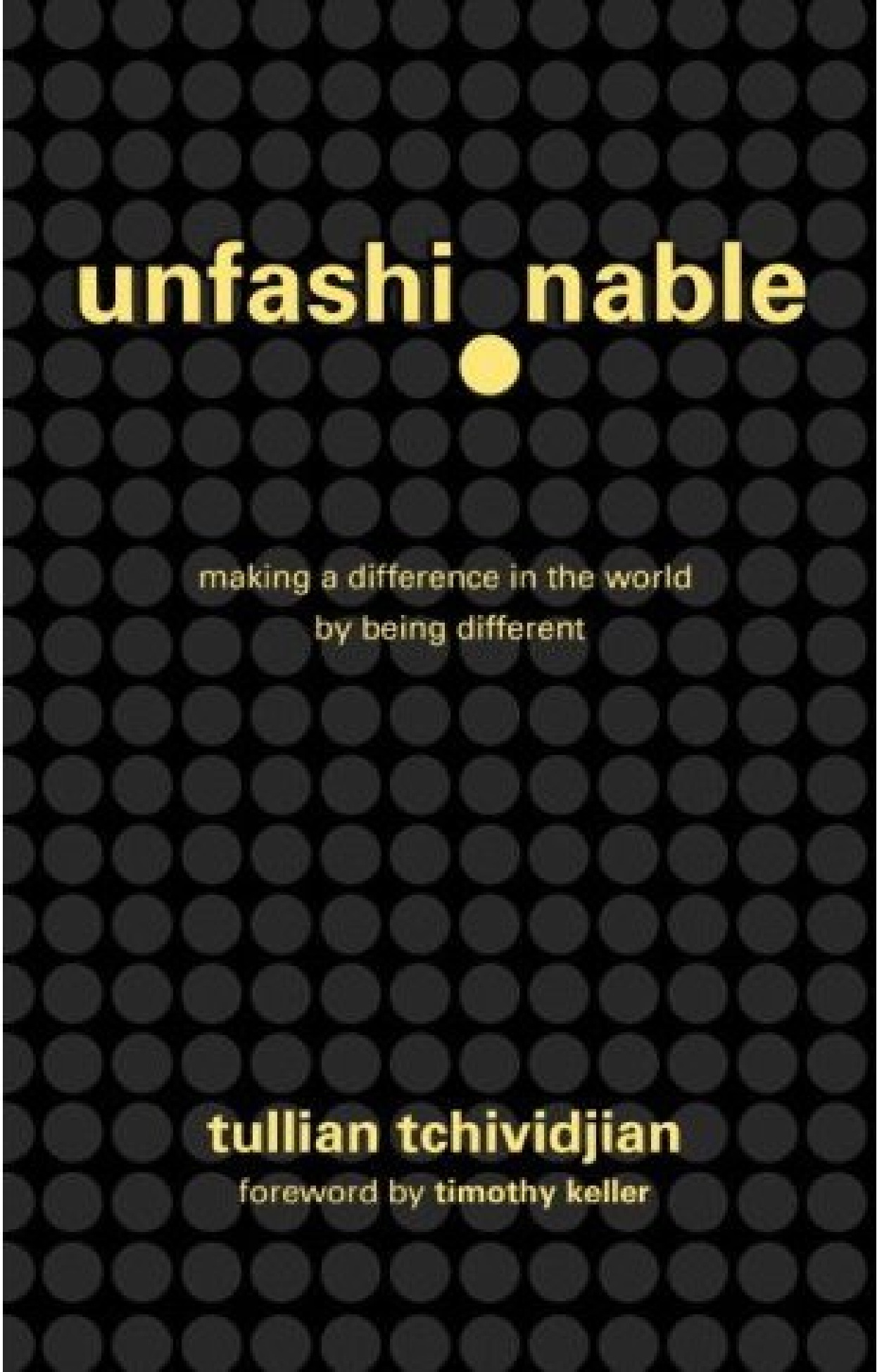
 Title: Unfashionable: Making a difference in the world by being different
Author: Tullian Tchividjian
Publisher: Multnomah Books, 2009; 204 pp. $17.99
Recommendation (4-star scale): 
This morning I was in a meeting at the church when an unknown man came to my office door, introduced himself and said that he had a financial need — could we help him with some gas for his vehicle so he might get to and from work this week?
After getting more information from him, I happily took him to the gas station down the street, filled his gas tank, and shared the gospel with him, leaving him some additional information about the gospel.
Such a circumstance is not unusual — and it inevitably raises many questions in my mind about how I — as an individual — and we — as a church — are to be involved in the lives of our community and culture. What does it mean to be a Christian in the culture, and what and how do we help people with tangible (non-spiritual) needs in a way that accurately reflects the person and character of Christ?
This is neither a new or unaddressed question, and it is the question that Tchividjian (pronounced cha-vi-jin) addresses in his new book, Unfashionable. The self-stated intent of the book is that “Christians make a difference in this world by being different from this world; they don’t make a difference by being the same.…I’m asking you to embrace the delicious irony that Christ demonstrated in bringing a message of God’s kingdom that subversively transforms both individuals and the world. Only by being properly unfashionable can we engage our broken world with an embodied gospel that witnesses to God’s gracious promise of restoration, significance, and life.” [his emphasis]
So for Tchividjian, being unfashionable has two implications: the believer is out of step with the world in that he refuses to use worldly principles and desires to influence the world for Christ, but he also is out of step with much of the church that refuses to engage the world for Christ. Being unfashionable thus means being unworldly, but still deeply compassionate for the lost in the world.
The first four chapters provide a foundation for being unfashionable in the eyes of the world, while the remainder of book fills out the idea of being unfashionable in the eyes of much of Christendom in relation to interaction with the world. Those first four chapters are the strongest and most helpful part of the book. Tchividjian provides clear illustrations of how the church unwittingly has become overly influenced by the culture of the world, as well as offering some helpful explanations of why the church is susceptible to such temptations.
The relevance of the church doesn’t depend on its ability to identify with the latest cultural trends and imitate them, whatever they might be. “The ultimate factor in the church’s engagement with society,” [Os] Guinness says, “is the church’s engagement with God,” not the church’s engagement with the latest intellectual or corporate fashion.…Our main problem is not that we’re culturally out of touch; it’s that we’re theologically out of tune. [p. 15]
The faithful, according to Jesus, are not intended to be fashionable. They’re not supposed to fit in. They’re called out from the world to be “odd.” Our oddness, in fact, is essential to our faithfulness. To put it another way, faithfulness to Christ requires foreignness to the world’s trendy diversions. [p. 24]
That is said so very well and with great insight. This is the section of the book that not only resonated with me, but caused me to ask, “how am I and how is my ministry being influenced by worldly motives and practices in ways that I may be blind to seeing?” That’s helpful.
What was less helpful (and why I gave this book only two stars) was his “solution” section. Here he notes, “God intends his people to be a visual model of the gospel. He wants us to live our lives together in such a way that we demonstrate the good news of reconciliation before the watching world.” [p. 103.]
Two questions arise from that statement: why should we be a visual model of the gospel (i.e., what is the Biblical imperative driving that statement?). And how should we be a visual model? The later question is answered in the final 60 pages of the book as Tchividjian attempts to apply Ephesians 4:25-32 to the church’s ministry to the world. While there are some helpful ideas, Tchividjian stops short of clear articulation of the implications of caring for one’s community. Is he talking about buying gas for people who need it? Building homes for the needy? Purchasing people out of slavery in Africa? Running a food pantry or a medical clinic in the church? Lobbying against the pornography industry? The reader is unsure of how far this care for the community should go (and how it relates to gospel proclamation).
Of greater concern to me is the question why — why should believers engage the world?
I do not disagree that we should demonstrate the gospel of Christ through tangible deeds; I do believe that the motive for doing it is terribly important, though, because the motive will determine the extent and manner in which such deeds are done. A couple statements from Tchividjian are instructive about his motive:
Christians are called to follow Jesus, to go where he’s going and to do what he’s doing. This is what it means to be his disciple. And the New Testament clearly teaches that Jesus intends to bring about the restoration of all things — he’s working in the direction of total transformation. Knowing that this is what Jesus is doing and where he’s going, Christians are disobedient to the degree that they refuse to follow him in these ways. It’s the chief business of every true disciple to be working toward the same end Christ is working toward. The alternative would clearly be sinful non-compliance — thumbing our noses at God’s plan. [p. 57; his emphasis]
[Thus] In the meantime — the time between Christ’s first and second comings — we, the people of God, have been commissioned to serve as God’s agents of renewal, with our own resurrection serving as the pattern for the resurrection of all creation. [p. 60]
Therefore, the mission of the church is spiritual and physical, individual and cultural. God wants us to involve ourselves in the rehabilitation of hearts and houses, souls and society. We’re to care about the renewal of both people and the environment. This requires word and deed, proclamation and demonstration. God is renewing human hearts and recreating all things through his church. This is our mission to the world. [p. 62]
There are some problems theologically with those statements. First of all, it is true that Jesus intends to bring about the restoration of all things. But the point is that Jesus is going to bring about the restoration of all things. Scripture does not state that because Jesus will do that, we should now be doing the same. The very point of Christ’s restoration (both of me spiritually, and the world physically) is that I cannot restore all things. We do not attempt to bring about the restoration of all things for the very reason that we cannot — only Christ can.
Secondly, it is a huge leap to say that anytime Jesus does something, I must do the same. That was the inherent problem of the WWJD bracelets a few years ago — I cannot do what Jesus did because in my flesh I am not fully righteous, nor am I deity (not to mention that I do not have the infinite mind of Christ to know what He would do in any given situation — something even the disciples struggled to comprehend while Christ was on earth!).
Thirdly, we best be careful about defining the great commission — are we sure that we want to enfold cultural redemption into the gospel? Just what does he mean, that we are to be involved in the rehabilitation of society? to renew the environment? One thing is clear from Scripture — that will not happen prior to the coming of Christ. Period. Making that a priority of the church is a failing venture.
Finally, while I appreciate the quest Tchividjian is pursuing in writing this book — how can the church as an organization and believers as individuals impact the culture in such a way that the gospel is advanced? — unfortunately, Tchividjian spends more time quoting other authors than he does Scripture. Undoubtedly, he has researched his topic well (his footnotes as well as the book list he offers give testimony to this). He obviously has read widely and significantly about the topic. I just wish he had incorporated Scripture as the foundation for his arguments rather than other writers. So, while affirming early in the book that Scripture is the final guide for believers, the tenor of his book is that the ideas of other writers hold greater sway over his thinking than Scripture.
The church does need clear thinkers guiding her through the labyrinth of conflicting ideas on the gospel and its implications for serving the world. Unfortunately, Unfashionable still falls short of giving us a Biblical model of how this might be done.
 Words of Grace