
Title: The Disappearance of God: Dangerous Beliefs in the New Spiritual Openness
Author: R. Albert Mohler, Jr.
Publisher: Multnomah Books, 2009; 194 pp. $14.99
Recommendation (4-star scale): 
A number of years ago while attending a conference where Al Mohler was preaching, reference was made to the fact that while Mohler is obviously articulate, well-read, and a prolific blog writer, he had not a single book in print under his own name.
That statement is no longer true. And that’s good news. The church is a better place for the writings of Al Mohler.
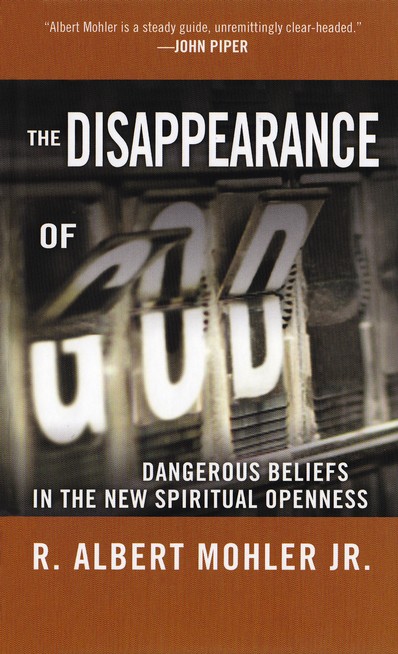 This latest volume is another compilation of essays on issues that are of concern to the church — issues both external and internal to her existence. “Intelligent and faithful Christians should know of these issues, and this book is intended to help believers to understand what is at stake,” he writes in the preface.
What are some of those important issues?
- perseverance of the saints
- the disappearance of sin
- hell
- beauty
- the emerging church
- openness theology
- church discipline
- postmodern thought
- missions and preaching
Some of these topics are single-chapter issues in this volume; others occupy two to four chapters. All are handled insightfully and Biblically as Mohler well considers the influence of cultural trends and Biblical instruction. In fact, that is the real value of Al Mohler’s writing. He is so well read that he is able to draw from multiple secular and sociological sources to demonstrate with accurate clarity what is happening in the culture and the church. But then his Biblical and theological astuteness shapes a response to those problems that provides direction for the church that is otherwise generally wandering and direction-less.
A couple of examples:
Concerning beauty he demonstrates that true beauty is not subjective but objective and cannot be separated from good, truth and reality. So, he writes:
…that which is a delight to the eyes may very well be unbeautiful. Our human temptation is to substitute the truly beautiful for that which is merely a delight to our senses or our eyes, and thus also are drawn to forbidden fruit of a corrupt and fallen culture. [p. 59]
…the Christian worldview explains why the face of a child with Down syndrome is more beautiful than the cover girl in the fashion magazine. The unity of the good, the true, and the real calls us to look below the surface and to understand that the ontological reality of every single human being is that we are made in the image of God. The imago Dei is the beauty in each of us, and the rest is but of cosmetic irrelevance. [p. 67; my emphasis]
So a Biblical comprehension of beauty not only provides dignity to those increasingly considered irrelevant (the weak, the simple, the plain and unattractive, the disfigured), but it also provides clarification for the person struggling to conform his lustful thoughts to the glory of God. [Aside: He also spoke on this topic at Capitol Hill Baptist Church’s Henry Forum.]
As another example, in a pair of essays on postmodern thought, Mohler concludes:
I fear that as evangelical Christians, we tend to swing like a pendulum between a naive optimism and a wrongful pessimism. In reality, we have no right to be either optimistic or pessimistic. To be either optimistic or pessimistic is to be deluded, and in some sense to deny the sovereignty of God. We cannot be pessimistic because Scripture tells us we are to be a people of hope. Of course, that does not mean that we are a naive and ignorant people of hope who close our eyes to the reality around us. No, we find hope in something that si for more secure than anything this culture can secure.
But, on the other hand, we cannot be optimistic either. Optimism is the message sent down from public relations. Optimism is the happy face that tells us with a chipper voice that everything is all right. Well, it is not all right, and everything will not be well, not in this age or in this life. We have no right to be optimistic, but we have no right not to be hopeful. [pp. 173-4.]
He is exactly right — most of us do tend toward one or the other of pessimism or optimism, and sometimes on the same day! His ministry and this book are a faithful attempt to see with clear, non-rose-colored glasses the reality of the circumstances in which the church finds itself today, and then point with accuracy to the answer of the hope of Christ and His Word.
So read Al Mohler — read his blog and read this book — and find yourself gaining a perspective on important issues facing a church that conforms more closely to the truth of God’s Word.
 Words of Grace