
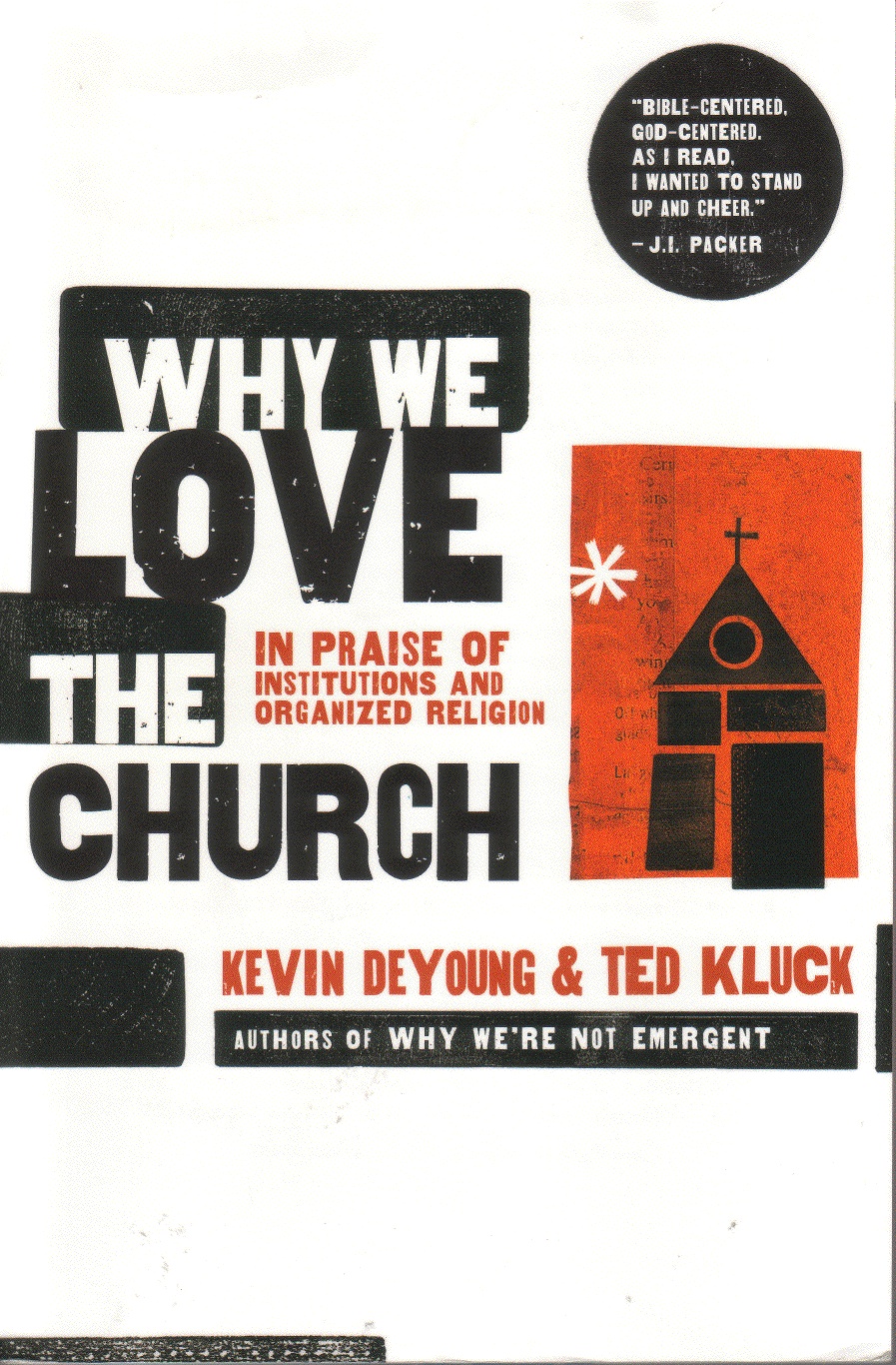
 Title: Why We Love the Church: In Praise of Institutions and Organized Religion
Authors: Kevin DeYoung and Ted Kluck
Publisher: Moody Publishers, 2009; 234 pp. $14.99
Recommendation (4-star scale): 
Well-written books are becoming a trend for Kevin DeYoung. Just three years ago, he published his first book, and just 18 months ago he published his first book that had wide distribution. Now he joins Ted Kluck again to write his fourth book and the third that I’ve read (see also Why We’re Not Emergent and Just Do Something). Like his previous books, this one is profoundly helpful and as a companion to Why We’re Not Emergent, it also is an important book.
When I first became aware of the emergent church a few years ago, it seemed quickly obvious to me that much of what was driving that movement was disenchantment with the local church. Individuals had been sinned against, “burned,” hurt, and overwhelmed with a variety of ills that at times influence and even plague the church. In their discouragement, these individuals left the church, but not wanting to forsake their spirituality and connectedness to other believers, they formed a new kind of church was after their own making and style more than out of the making of Biblical principles.
The first collaboration between DeYoung and Kluck, Why We’re Not Emergent, was a very helpful warning about the dangers of the emergent movement. This complementary volume now sets out to explain what is good and right about the church — for all its failings and weaknesses — and why believers should maintain a commitment to the church.
In the introduction, DeYoung identifies the nature of the problem:
Increasingly we hear glowing talk of a churchless Christianity. It is easy to read any number of personal memoirs where professing Christian men and women tell their tale of disenchantment with the local church and their bold step away from church into what, they would say, is a fuller, more satisfying Christian life. These days, spirituality is hot; religion is not. Community is hip, but the church is lame. Both inside the church and out, organized religion is seen as oppressive, irrelevant, and a waste of time. Outsiders like Jesus, but not the church. Insiders have been told that they can do just fine with God apart from the church. [pp. 12-13]
DeYoung asserts that this is akin to a decorpulation of the church — a removal of the body, the church, from its head, Christ. DeYoung and Kluck are committed to a simple premise: “We don’t want Christians to give up on the church.” [p. 14]
To that end, DeYoung and Kluck combine their two distinct styles of writing — DeYoung the theologian pastor with endnotes, Kluck the church member with anecdotes and analogy — to address four primary attacks against the church:
- The church just doesn’t work any more — it isn’t growing while the problems in our culture are. It’s time to try something new.
- The church has an image problem — it is “filled with hypocritical, antiwomen, antigay, judgmental, close-minded acolytes fro the Republican party.…[And] Many church insiders have an equally negative impression. They feel personally wounded or let down by the church. They find the church legalistic, oppressive, and hurtful.”
- The historical church is anti-Biblical — a corruption of the first century church, and all the practices and activities of the church is the result of falling into “syncretistic, over-institutionalized religion,” that may even be more a reflection of paganism than the Bible.
- You don’t need to be part of an institution to be part of the church — the church is important in the New Testament, but all you need for the church to be the church is two or three believers gathered together for encouragement — even two believers on the golf course is as much the church as 75 or 2000 people gathered in a sanctuary.
Each chapter of the book is designed to answer one of these allegations, with DeYoung answering the criticisms from a Biblical perspective and Kluck from more of an anecdotal perspective. Together they combine to offer a sound refutation to these complaints.
For instance, in answering the accusation that the church is declining in attendance, indicating that the church is missing its objective and needs replacement, DeYoung notes that 37 percent of Americans still attend church at least monthly and 52 percent are members of some institutional church. Moreover, most of the decline that is typically lamented is within mainline denominations and the Roman Catholic church while the evangelical church actually grew in the past 15 years. So the numbers may not necessarily support the accusations that are being made.
Moreover, he also reminds readers of the theological truth that, “Didn’t Jesus…tell us that ‘the gate is narrow and the way is hard that leads to life, and those who find it are few’ (Matt. 7:14)? Wasn’t the early church of Philadelphia commended by the Lord Jesus even though they were facing opposition and had ‘little power’ (Rev. 3:7-13)? There is simply no biblical teaching to indicate that church size is the measure of success.” [p. 31]
Such helpful instruction and encouragement permeates this book —
God will not reward churchgoers, or His churches for that matter, for being big and influential, or hip and culturally with-it, but for being good and faithful (Matt. 25:23). That’s all God asks of us — be good and faithful, which is right, because that’s the best that we can do. [p. 36]
It can be helpful to know how others perceive us, but not always. In our self-esteem-oriented, easily offended, suffering-averse world, I fear that the church is too eager to be liked.…Of course Christianity has an “image problem.” At times, this is our own fault. But at other times, our lack of an image problem has been just as damning. We’ve been indistinct from the world with nothing to set us apart, nothing to suggest a transformed life or renewed thinking bound by the Word of God. [pp. 80-1.]
Church isn’t boring because we’re not showing enough film clips, or because we play an organ instead of a guitar. It’s boring because we neuter it of its importance.…At the end of my life I want my friends and family to remember me as someone who battled for the gospel, who tried to mortify sin in my life, who fought hard for life, and who contended earnestly for the faith. Not just as a nice guy who occasionally noticed the splendor of the mountains God created, while otherwise just trying to enjoy myself, manage my schedule, and work on my short game. [p. 102]
It’s true that a church is more than a sum of its worship services. But a church that does not assemble for regular corporate worship is not a church. Worship services are not peripheral to the life of the church.…Our gathering for worship is an exercise in covenant renewal, a weekly celebration of the resurrection, and a foretaste of the heavenly banquet to come. [pp. 171-2.]
In addition to the solid defense of the church and its position in the life of the believer, DeYoung and Kluck do not gloss over the problems within the church — they readily acknowledge that there are sins that are committed within the church and that churches sometimes wrongly prioritize preferences over truth. Yet these realities do not mean that the church must be dismissed as arcane and obsolete. Rather, that believers must live together in commitment to one another within the church for the hope of the gospel and the glory of God.
DeYoung’s final thought is a fitting conclusion:
So I guess here is my final advice: Find a good local church, get involved, become a member, stay there for the long haul. Put away thoughts of revolution for a while and join the plodding visionaries. Go to church this Sunday and worship there in spirit and truth, be patient with your leaders, rejoice when the gospel is faithfully proclaimed, bear with those who hurt you, and give people the benefit of the doubt. While you are there, sing like you mean it, say hi to the teenager no one notices, welcome the blue hairs and the nose-ringed, volunteer for the nursery once in a while. And yes, bring your fried chicken to the potluck like everyone else, invite a friend to church, take the new couple out for coffee, give to the Christmas offering, be thankful that someone vacuumed the carpeting, enjoy the Sundays that click for you, pray extra hard on the Sundays that don’t, and do not despise “the day of small things” (Zechariah 4:10). [pp. 226-7.]
Read this book and fall in love again with the bride who is loved by Christ.
 Words of Grace
Sounds like a solid book. Probably would be great reading for John. More interested in Daniel commentaries these days, but me thinks I should buy it and keep it on the (books to read)stack, along with the 2300 others.
Gary