

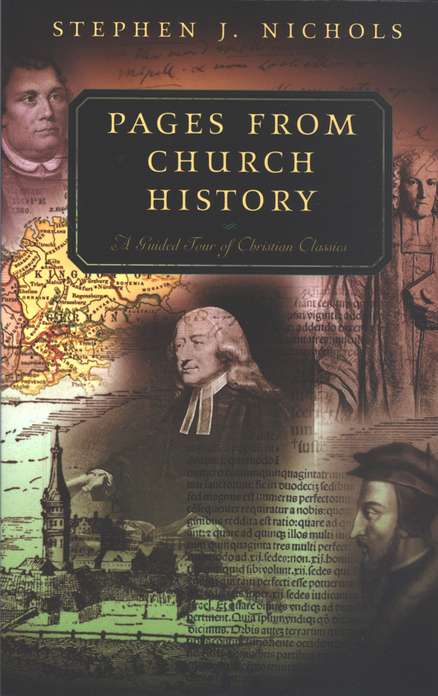
 Title: Pages from Church History: A Guided Tour of Christian Classics
Author: Stephen J. Nichols
Publisher: Crossway, 2006; 329 pp. $15.99
Recommendation (4-star scale): 
What is the best book you have read in the past year?
What is the most important book you have ever read?
What is the most important book written in the past century? Millennium? History of the church?
It is this final question that Stephen Nichols attempts to answer — what are the dozen most significant works in the history of the church? There is no easy answer to the question, but Nichols does a fine job of providing justification for the choices he has made.
The reason for this quest is not only to recite some of the poignant portions of church history, but “this book is a means to an adventurous journey of reading not about church history, but reading the actual texts that constitute it. These texts, however, can be daunting. Simply thumbing through Augustine’s Confessions can be intimidating. This book helps by providing a context, walking through the text, and pointing the way for further exploration.”
Nichols has divided the history of the church into four eras (the ancient church, the medieval church, the reformation, the modern era) and offered 2-4 authors and a primary work for each writer as essential for that era. The writers he selects are: Polycarp, Augustine, Anselm, Aquinas, à Kempis, Luther, Calvin, Bunyan, Edwards, Wesley (both John and Charles), Carey, and Bonhoeffer.
Undoubtedly, arguments could be made against some of these writers, and for others (e.g., might Packer be a more influential author than Bonhoeffer? Whitfield more than the Wesleys? Owen rather than Bunyan?). Yet Nichols’ grasp of church history enables him to provide compelling arguments for each of his choices.
The book is very readable — each chapter provides a summary of the history of the church and culture of the era under consideration, an overview of the writer selected for that time, an overview of that person’s writings in general, an overview of that individual’s most prominent work, and then a summary of his legacy. The clarity of Nichols’ writing style makes for compelling reading, so the pages turn quickly.
With his approach of considering significant writings, Nichols has made appealing what is generally considered a dreary subject — history in general and church history in particular. This isn’t just a book about history, it’s a book about literature and preachers and theologians, and their individual stories and works make the history of the church more approachable and appreciated.
Also of considerable help is his first chapter, “A Quick Look at the Big Picture,” in which he surveys the flow of the 2000 years of church history.
Polycarp and Bonhoeffer, as well the many generations stretching in between, remind us that in the end we are all pilgrims, called to travel through this world as faithful witness-bearers to the gospel and called to our true home, Zion, the city of our God and King. This task is now undertaken by the twenty-first century church.
Since Nichols has framed his book around the books of others, the true test of his work must then be, “am I stimulated to read what he has encouraged us to read?” And since at least one of the works he selected has made it to my “read this year” list, this book is a success. I commend it to you to stimulate your understanding of church history, and to feed your interest in other good Biblical and theological reading.
 Words of Grace