
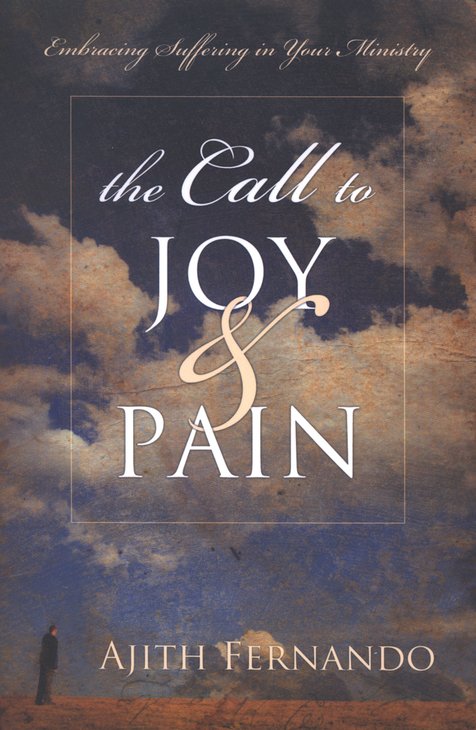
 Title: The Call to Joy and Pain: Embracing Suffering in Your Ministry
Author: Ajith Fernando
Publisher: Crossway, 2007; 192 pp. $14.99 ($7.99 as an ebook)
Recommendation (4-star scale): 
For many generations, the Western church — and especially the American church — has sent missionaries with the message of the gospel to other countries. The church in America has had sufficient financial and theological resources that it was able, willing, and wise to share with the rest of the world.
And now this wealthy church has received instruction and ministry from the “poor” arm of the church as Ajith Fernando, national director of Youth for Christ in Sri Lanka, has gifted us with a volume about understanding the role of suffering in the spiritual life.
Let’s be honest, most of us don’t like the idea of suffering, we do all we can to avoid suffering, and we justify a measure of discontentment when we suffer. Fernando calls all those motives and thoughts into question with his excellent volume of the role of suffering in the life of the believer.
He packages 30 brief meditations into four categories:
- Suffering and joy are basic to Christianity
- Suffering brings us nearer to Christ
- Our suffering helps the church
- Servants of the church
The first section provides the Biblical foundation for Fernando’s contention that suffering and joy are not only not incompatible, but that they are actually designed by God to work together. Suffering, while at times being lamentable, is to produce joy in the life of the believer. This does not mean that the believer should pursue suffering and look for opportunities to suffer. Nor does it mean that there is never a time for a believer to seek to escape suffering. Yet, when suffering does come, as it inevitably will, the believer should find joy in God sovereignly working His purposes in the believer’s life.
The “good life,” comfort, convenience, and a painless life have become necessities that people view as basic rights. If they do not have these, they think something has gone wrong. So when something like inconvenience or pain comes, they do all they can to avoid or lessen it. One of the results of this attitude is a severe restriction of spiritual growth, for God intends us to grow through trials. [p. 52]
And the personal growth in maturity are not the only benefits of suffering. The gift of suffering also brings increased fellowship and intimacy with Christ, produces benefits in the church and is a means to being servants of others and the church. In other words, the benefits of suffering are almost immeasurable to the one who suffers — it produces far more than he might imagine. A few sample statements from this book that affirm that reality:
If you want to have a deep impact on this world, you will have to suffer. [p. 103]
Painful situations sometimes linger for a long time. But commitment causes us to persevere without giving up. [p. 120]
The important thing is not what we do for God but what God has done for us. [p. 134]
…we should never present the cost of service without the underlying confidence that it is accompanied by joy and a reward that outstrips the cost.…If we look at life here [on earth] as a temporary abode, we won’t be too upset by temporary setbacks. Neither will we be too upset when the wicked prosper by being wicked while our progress in society is hindered by our refusal to break biblical principles. The discomfort of the righteous is like the discomfort of a person who is going in an uncomfortable vehicle on a short ride to heaven. [pp. 139, 147]
What this book does so well is to provide a clear and biblical evaluation of what God has designed suffering to do in our lives. We are too easily seduced by the idols of comfort and ease. Risk and suffering, we believe, are to be avoided at virtually all costs. But that’s not so. What is necessary for the believer is to have Christ and to serve Christ. And suffering is often the best and most effective means to those ends. As Fernando reminds us:
…when Jesus is everything to us, suffering is not a huge problem. If we have him with us, we have what matters most. His love for us gives us the joy that becomes our strength. Then we can bear suffering and remain totally fulfilled human beings in the midst of it. [p. 178]
The strengths of this book (which is an expansion of three talks Fernando gave at the 2006 Bethlehem Pastor’s Conference, “How Must a Pastor Die?”) are three-fold: it is sound in its biblical analysis and exposition, it abounds with personal and historical examples of the principles reinforcing the idea that not only is this God’s calling, but God has also equipped and enabled us to endure suffering with joy, and finally, each chapter is brief, making it easily readable in a month (30 readings) by reading only 5-10 minutes each day.
Read this book if you know anyone who has suffered or is suffering, if you have suffered, or if you might suffer in the future. (In other words, read this book. You and I both need to read and re-read these admonitions.)
 Words of Grace