
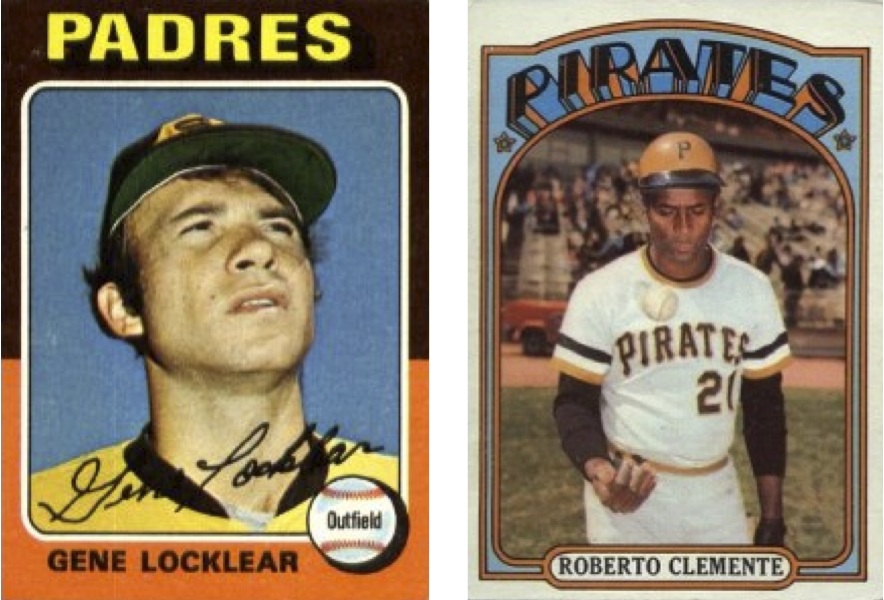
 In my childhood and early teen years, I was an active baseball card collector. (I still have something around 30,000 cards inhabiting my closet.) One of the things that I would like to do with fellow card-collecting buddies was trade cards. I always tried to be strategic in my trading, and since one of the goals was to accumulate a complete set, I never would trade anything but duplicates. And of course you always wanted to trade up — giving up a card of lesser value for a card of greater value. So, since I had an abundance of early-model Gene Locklear cards, I was always looking to upgrade it into something like a late-model Roberto Clemente. Sadly, no such trade existed (though I was able to procure a Whitey Ford and a Roy Campanella on one occasion).
In life, there are many kinds of trade-offs: a pair of twenty-somethings give up the freedoms of singleness for the security and joy of marriage; a man declines a promotion in exchange for the privilege of a more family-friendly schedule; and a couple of repairs the 8-year-old family car instead of upgrading to a newer model to pay for a medical procedure for their child.
But no trade is greater and more significant than what an individual gives up in return for eternal life and following Christ. So Jesus says in Luke 14: “For which one of you, when he wants to build a tower, does not first sit down and calculate the cost to see if he has enough to complete it?…So then, none of you can be My disciple who does not give up all his own possessions” (vv. 28, 33).
In other words, there is a cost to following Christ, and the one who will be counted as Christ’s must consider that cost. And the cost is possessions. Now don’t misunderstand. Jesus is not saying that His salvation can be procured by buying and selling. He is not suggesting that sacrificing a few (or even all our) material possessions will guarantee spiritual life and eternity in heaven.
No, this passage is similar to the first commandment to the Israelites: “You shall have no other gods before Me” (Ex. 20:3; Dt. 5:7). And it sounds a note like Is. 46:9 — “Remember the former things long past, For I am God, and there is no other; I am God, and there is no one like Me.” And it aligns itself with Jesus’ earlier words, “No one can serve two masters; for either he will hate the one and love the other, or he will be devoted to one and despise the other. You cannot serve God and wealth” (Mt. 6:24).
Jesus’ call for counting the cost of following him is a test to see if there is anything that we value above Him. Do we want Him preeminently and alone, or do we want our baseball cards or marriage or children or a promotion or a manicured yard or anything else alongside Him or above Him? Because we cannot have anything above Him. We have Him or we have some other temporal treasure. But we will not have both. Count the cost. What do you want?
Also notice though, that this examination is not part of a sadistic plan of God to remove all our joy and happiness. No, we and the disciples are exhorted to count the cost so that we can finish well: a builder calculates costs to assure the completion of the building (the word “finish” is repeated in vv. 29 and 30 to emphasize this) and a king considers the size and strength of his army so that he isn’t destroyed. And the believer considers the costs of following Christ so that he also has what is of greatest value at the end of his life. That’s what it means to finish well — it means to reach the end of life embracing and loving Christ more than anything else and hearing His words of affirmation, “‘Well done, good and faithful slave. You were faithful with a few things, I will put you in charge of many things; enter into the joy of your master’” (Mt. 25:21, 23).
So count the cost. And count the cost with the goal of finishing well.
 Words of Grace