
Construction worker Patrick Lawler thought he had a toothache. He tried painkillers and ice packs but received no relief. Finally he went to the dental office where his wife worked and the x-ray revealed the problem: he had a four-inch nail in his head. Apparently six days earlier Patrick’s nail gun misfired and one of the nails shot into his mouth and embedded itself in his head, narrowly missing his right eye.
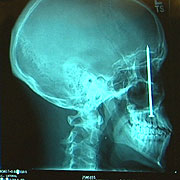
After a four-hour surgery to remove the nail, a neurologist admitted that it was a “pretty rare injury…but this is the second one we’ve seen in this hospital where the person was injured by the nail gun and didn’t actually realize that the nail had been embedded in his skull.”
Poor Patrick felt a pain but made a misdiagnosis of the source of his problem. He exemplifies the truth that a patient most often makes a poor doctor for himself. The same is often true spiritually. We are blind to our sin or misdiagnose the source of our sin and the root of our problem.
Such was the problem for a highly successful young man who met Jesus one day and decided he’d like the eternal life that Jesus was offering (Mt. 19:16-22). It would be one more worthy achievement, he apparently decided, and thought he might like to procure that life for himself. “What can I do to get it?” he asked. “Obey the Law,” Jesus replied.
One can imagine him pausing for a moment and contemplating his achievements in “Law Fulfilling” before asking, “which ones?” — as if there were none that he hadn’t conquered. So Jesus listed a few (in fact, he listed the entire second table of the Law):
- you shall not commit murder
- you shall not commit adultery
- you shall not steal
- you shall not bear false witness
- honor your father and mother
- you shall love your neighbor as yourself
The young man obviously hadn’t been at the Mount when Jesus delivered His sermon there (Mt. 5-7) because he answered, “I’ve already done all that; what else should I do?” (my paraphrase).
He missed the lesson that the heart of murder is anger and the sin of adultery is rooted in lust and that the standard of obedience is not “kind of fulfilled,” or “mostly fulfilled,” but “fulfilled completely and perfectly always” (Mt. 5:48).
Watching such a scene unfold, we might have self-righteously muttered, “He’s delusional.” And we’d be right. He was deluding himself. He self-righteously deceived himself into thinking that he had no need for transformation or change and that there was no form of sin conforming his life to the world.
But the tragedy is not merely that this arrogant young man was deluded. The tragedy is that we are also deluded. We share his same propensity to lie to ourselves. It is for that reason that the Psalmist says that one of the marks of integrity and righteousness is that one does not lie in his heart to himself or about himself (Ps. 15:2). While we are to examine our own hearts (2 Cor. 13:5), we are often the least equipped to see the true condition of our hearts because of our own deluding influence over ourselves.
“We deny…what we know to be true. We assert…what we know to be false. We prettify ugly realities and sell ourselves the prettified versions…We become our own dupes,” Cornelius Plantinga has written.
So what do we do? David Powlison is right when says, “You need a clear-eyed realism about the human tendency towards self-blinding.” We need to understand the danger of self-deception and acknowledge that we — that we, ourselves — are tempted to willfully blind ourselves each day.
God, give us eyes to see the true nature of our hearts, and wills that love to be conformed to Your will, no matter the pain that ensues from the surgical removal of the four-inch nails of our sins.
 Words of Grace