
“The Son of Man’s Authority to Call His Own”
Luke 6:12-19
May 11, 2025
In virtually every realm of life, there are questions about authority — the question is often cynically asked, “who died and left you in charge?” The debate about authority and what the authority can and can’t do is seen between people and government, in marriage with husbands and wives, in homes with parents and children, in churches with elders and people, in work places between bosses and employees, and even in civic organizations between leaders and workers. The question is typically about authority and right to exercise leadership. Questions of authority were evident in Christ’s ministry as well.
The first several months of Jesus’ ministry, He traveled alone. He taught and healed and ministered in large crowds and He began accumulating a large following of people who identified themselves with Him, but He was alone in His travels. He had begun His ministry in the region of Judea in the southern part of Israel (John 1-2), and then traveled north to Galilee (Luke 3-6). While there were questions from the religious leaders in Judea, it was in Galilee after a few months of ministry that Jesus began facing real opposition that intensified significantly in 6:11 — “[The Scribes and Pharisees] were filled with rage, and discussed together what they might to Jesus.”
The opposition to Jesus was because of His authority. He came as the Son of Man (Dan. 7:13-14) who was given eternal authority by the Ancient of Days over all people and nations. And Jesus’ ministry demonstrated that authority. What Luke 4-6 repeatedly emphasizes is that…
As the Son of Man, Jesus is authoritative to call His disciples.
Luke has explained His authority as a teacher, over demons, over other illnesses, over men to compel them to follow Him, His ability to cleanse and heal, and His authority over the Sabbath and religious ritual.
And the religious leaders didn’t like that authority because it meant that they were not authoritative. So they rebelled and plotted against Him. It is in that context, that Jesus then offers one final demonstration of authority — His authority over people and His right to call His own — His disciples. This is similar to what we have already seen in 5:1-11, 27-28, but it is broader (more men) and more specific. In this section, Luke demonstrates Christ’s authority over men in three ways…
- The Son of Man is Lord of Men — He Works in Union with the Father (v. 12)
- The Son of Man is Lord of Men — He Compels His Followers (vv. 13-16)
- The Son of Man is Lord of Men — He Authoritatively Teaches and Heals (vv. 17-19)
Download the rest of this sermon on Luke 6:12-19.
The audio will be posted on the GBC website by Tuesday.
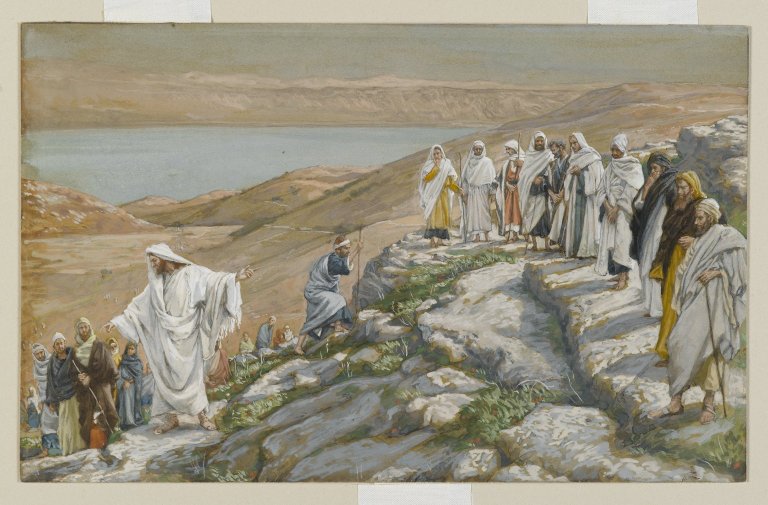
James Tissot, “Ordaining of the Twelve.” Public domain, via Wikimedia Commons.
 Words of Grace
_-_James_Tissot.jpg)