
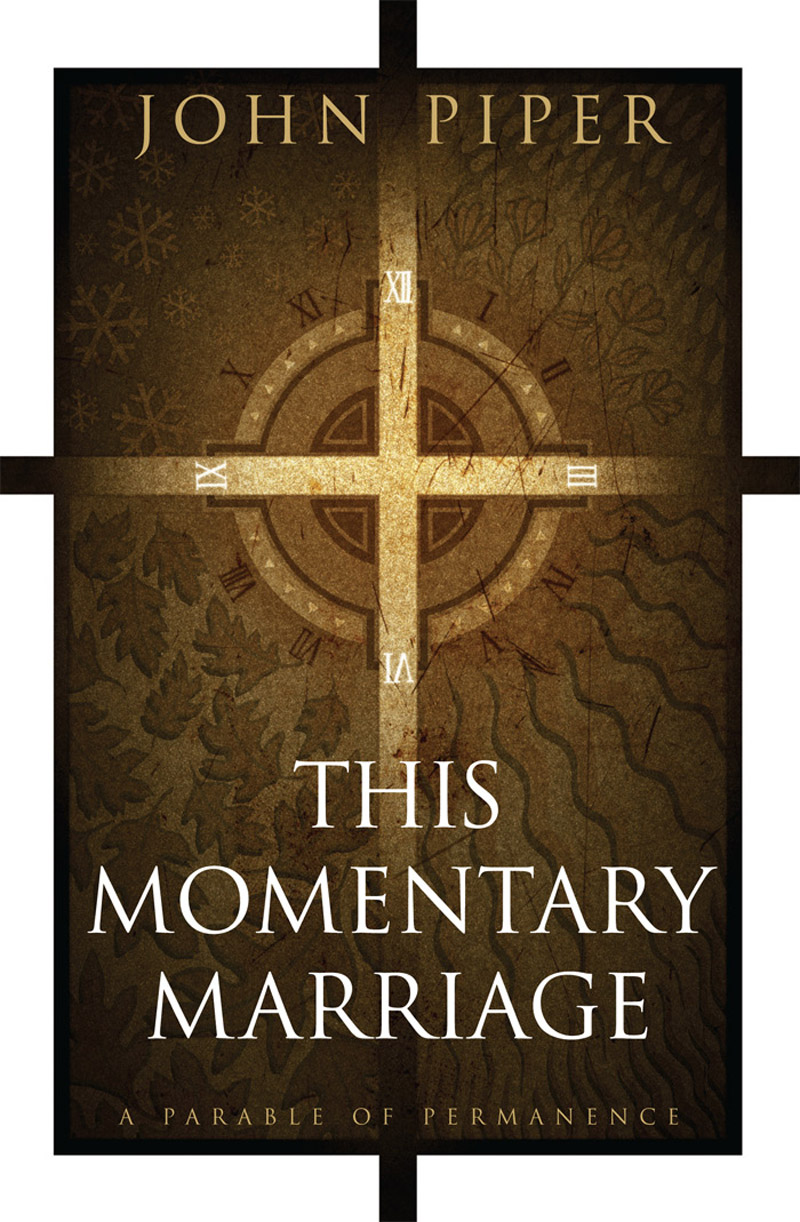
 Title: This Momentary Marriage
Author: John Piper
Publisher: Crossway Books, 2009; 180 pp.
Recommendation (4-star scale): 
I suppose I own dozens of books on marriage, parenting, Biblical manhood, and the like. Not counting my counseling books, this topic accounts for something like 20 board feet of shelving in my library.
I have preached lots of sermons on similar issues — 30? 40? (Not counting weddings.)
I’ve heard many more sermons.
It has been getting moderately difficult to find something new and refreshing on the subject. Until now.
I’ve listened to hundreds of John Piper’s sermons. Some of my very favorite are his sermons on marriage. And now one of my favorite Piper books is also on the topic of marriage.
This Momentary Marriage is based on a sermon series he did in early 2007 (the book is also available as a free .pdf file).
The basic tenet of the book is that marriage on earth is designed to illustrate the marriage between Christ and His bride, the church. The “momentary” earthly marriage reflects the truth of the eternal heavenly marriage (hence, the title). With that as the foundation, Piper asserts that the primary bond of marriage is not love, but covenant — the promise and commitment to remain in a marriage.
The most foundational thing to see from the Bible about marriage is that it is God’s doing. And the ultimate thing to see from the Bible about marriage is that it is for God’s glory.…Most foundationally, marriage is the doing of God. And ultimately, marriage is the display of God.…
Staying married…is not mainly about staying in love. It is about keeping covenant. “Till death do us part” or “As long as we both shall live” is a sacred promise — the same kind Jesus made with his bride when he died for her.
Working through the familiar passages in Genesis 2 and Ephesians 5, Piper demonstrates the great extent of God’s covenant love with His people, and Christ’s covenant love with His church, and then makes application for how husbands and wives might use those truths in their own momentary, earthly marriages.
For instance, as a believer is counted righteous in Christ, though he is not yet in actual behavior and attitude fully righteous, so that believer should count his or her spouse to be righteous in Christ, though they themselves are not yet fully righteous. In other words, the truth of our vertical forgiveness and justification are “bent horizontally” toward our mates — a great “display of Christ’s covenant-keeping grace.”
He also goes to great length to demonstrate how that same justification results in forbearing (patience and grace giving) and forgiving in the marriage. And how the believer’s covenant relationship to Christ is the means of transformation for the husband and wife in their marriage.
Few things have a greater transforming impact on a husband or wife than the long-suffering, forgiving sacrifices of love in the spouse. There is a place for confrontation. There is a place for pursuing conformity to Christ in the covenant of marriage. Life is not all forgiveness and forbearance. Real change can happen. Real change ought to happen. Christ died to make it happen. And he calls us, husbands and wives, to love like that.
Of further help in the book are his definitions and explanations of headship and submission in the context of marriage. They too are rooted in the covenant, marital relationship of Christ to the church.
…headship is not a right to control or to abuse or to neglect. (Christ’s sacrifice is the pattern.) Rather, it’s the responsibility to love like Christ in leading and protecting and providing for our wives and families.…
Headship is the divine calling of a husband to take primary responsibility for Christlike, servant leadership, protection, and provision in the home.
Submission is the divine calling of the wife to honor and affirm her husband’s leadership and help carry it through according to her gifts.
In a similar fashion he deals with topics like singleness, sex, parenting, and divorce and remarriage. None of them are dealt with as isolated topics, but they are understood through the lens of God’s covenant love and Christ’s cross-sacrifice — and how this earthly marriage was created and designed to reflect what lies above and ahead.
Multiple times in the book, Piper noted that his wife encouraged him, while preaching the sermon series, “you cannot say too often that marriage is a model of Christ and the church.” It is the refreshing manner in which Piper draws out the implications of that truth that makes this book so compelling.
So not only is this now my favorite book on marriage, but one that I have already recommended and given away personally several times. And I commend it to you to read and re-read and apply.
 Words of Grace