
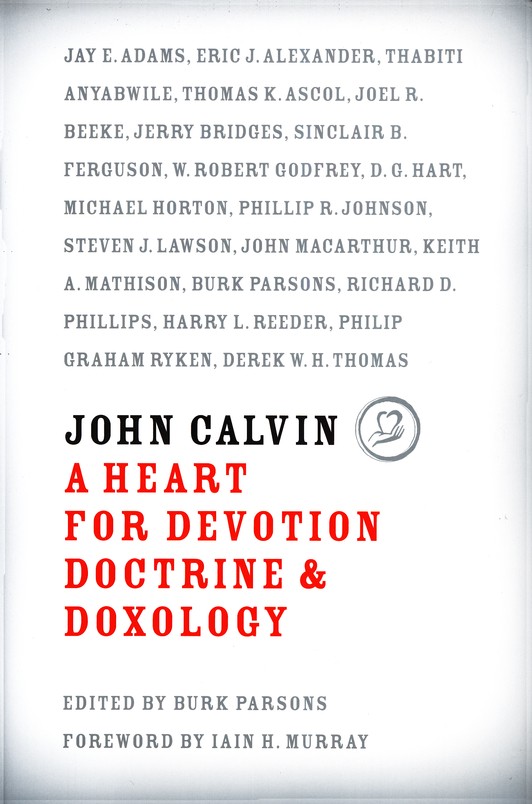
 Title: John Calvin: A Heart for Devotion, Doctrine & Doxology
Editor: Burk Parsons
Contributors Include: Jay Adams, Jerry Bridges, Sinclair Ferguson, Michael Horton, Steve Lawson, John MacArthur, Philip Ryken
Publisher: Reformation Trust, 2008; 257 pp. $19.00
Recommendation (4-star scale): 
This year, in honor of the 500th anniversary of John Calvin’s birth, I have focused more of my reading on Calvin — works both about him and by him. And I have been much encouraged and helped in the process.
I purchased this book near the end of last year and it sat on my shelf for some time before I picked it back up, and I’ve spent the last month or so working my way through the 19 essays that make up the book.
Most of these essays are not as much about Calvin the person (though there are a couple of those), but about Calvin and his theology and spiritual legacy. As noted above, the contributors to this volume make up something of a contemporary “who’s who” in the Reformed tradition (though conspicuously missing were R. C. Sproul and John Piper). Each article had a contribution to make, though a couple seemed somewhat scant in their insights.
Two articles alone made the volume worth the purchase price for me: “The Churchman of the Reformation,” and “The Principle Article of Salvation.”
In the former article, author Harry Reeder draws attention to Calvin’s role as a leader, preacher, teacher, writer, shepherd, and evangelist-missionary. What was most significant in this article is that final role of Calvin, for a common lament against Calvinism is its lack of evangelistic emphasis. Yet evangelism was central to his personal and ministerial life:
Calvin persistently evangelized the children of Geneva through catechism classes and the Geneva Academy. Moreover, he trained preachers to appeal for men and women to follow Christ. The visitation of the sick prescribed an evangelistic inquiry. Even a cursory examination of Calvin’s sermons reveals an unquenchable zeal for men and women to be converted to Christ.
But what about missions? In the Registry of the Venerable Company of Pastors, it is recorded that eighty-eight missionaries had been sent out from Geneva. In actuality, there were probably more than one hundred.…The blessing of God upon the missionary endeavors of Calvin and the Geneva churches from 1555 to 1562 was extraordinary — more than one hundred underground churches were planted in France by 1560. By 1562, the number had increased to 2,150, producing more than three million members.…
Calvin did not evangelize and plant churches in France alone. Geneva-trained missionaries planted churches in Italy, the Netherlands, Hungary, Poland, Germany, England, Scotland, and the independent states of the Rhineland. Even more astonishing was an initiative that sent missionaries to Brazil. Calvin’s commitment to evangelism and missions was not theoretical, but as in every other area of his life and ministry, a matter of zealous action and passionate commitment.
So Reeder is helpful in debunking some of the misapprehensions and misnomers about the impact of Calvin’s theology on ministry and missions, making this article particularly helpful.
The other article that was especially helpful for me personally was Michael Horton’s essay, “The Principle Article of Salvation.” Horton illustrates what Calvin centrally believed about justification, how believers are united to Christ, and what the implication of that justification and union is on sanctification.
As I told a couple people after reading that article, I felt that I had misunderstood sanctification for much of my life. Quoting from The Institutes, Horton draws attention to this statement:
…sons, who are more generously and candidly treated by their fathers, do not hesitate to offer them incomplete and half-done and even defective works, trusting that their obedience and readiness will be approved by our most merciful Father, however small, rude, and imperfect these may be.
Horton then draws this conclusion: “Once works are no longer presented to God for justification, they can be accepted despite their imperfections by a merciful Father for the sake of Christ.”
And later he adds that because we have in heaven not a Judge, but a gracious Father, we are freed “for the first time to obey God and serve our neighbor without fear of punishment for our shortcomings.…Although they play no role in God’s acceptance of us, even believers’ imperfect works are welcomed by the Father because their corruption ‘is buried in Christ’s purity and is not charged to our account.'”
So a believer’s works are “justified” in the sense that they are accepted entirely by God because of our union to Christ and His perfect righteousness being attributed and reckoned to us, yet they do not contribute to our justification. The latter part of the previous sentence is widely acknowledged by evangelicals — our works do not merit our salvation. Yet that the favor of God on all our works — even incomplete and imperfect works — is uncommonly known to believers (and misunderstood about Calvinism).
Because of the cross-work of Christ, we are justified, and because of the cross-work of Christ, we (and all our works) are entirely accepted by the Father. This, of course, is not to produce in us apathy to works, but rest and contentment that failure will not produce judgment and disavowal, but rather the loving correction of the Father and the continued application of Christ’s righteousness to those failures.
Here is not only a chapter that I will continue to reference and re-read, but also an encouragement to continue reading The Institutes myself so I might read the entire context of Calvin’s words.
So purchase this book for these two chapters — it’s worth it — and then read the rest of the book as well and reap the extra blessing of added insights into Calvin and Calvinism.
 Words of Grace