
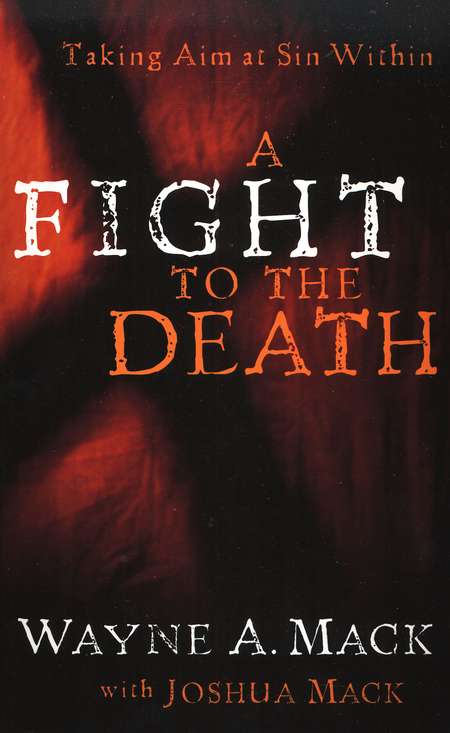
 Title: A Fight to the Death: Taking Aim at Sin Within
Author: Wayne A. Mack with Joshua Mack
Publisher: P & R Publishing, 2006; 176 pp. $10.99
Recommendation (4-star scale): 
Do you mortify, do you make it your daily work; be always at it whilst you live; cease not a day from the work; be killing sin, or it will be killing you.
Let no man think to kill sin with few, easy, or gentle strokes. He who hath once smitten a serpent, if he follow not on his blow until he be slain, may repent that ever he began the quarrel. And so will he who undertakes to deal with sin, and pursues it not constantly to the death. [John Owen]
Believers in Jesus Christ are to be killers — not of people, but of their flesh and sin in their own lives. So says not just John Owen, but so says the Word of God —
…for if you are living according to the flesh, you must die; but if by the Spirit you are putting to death the deeds of the body, you will live (Rom. 8:13).
Therefore consider the members of your earthly body as dead to immorality, impurity, passion, evil desire, and greed, which amounts to idolatry (Col. 3:5).
How to kill (or mortify) sin is a key component to a believer’s growth in sanctification. But just how to control the flesh and mortify sin is also a key question. Perhaps the best work on the subject is Owen’s classic, Mortification of Sin. However, for many, the 17th century English of this Puritan writer makes this work somewhat inaccessible for some readers. For them, A Fight to the Death is a good alternative.
The thesis of Wayne Mack is quite simple: “Sin is our enemy, and it wants to destroy us.” [p. 31] In the first section of the book, Mack expands that statement, demonstrating multiple reasons why killing sin is so important. Among the reasons: sin is a perversion of the truth of God, sin is a terrible master that will lead to more sin, sin is folly, and sin ignores the consequences of God’s wrath.
What exactly does it mean to put sin to death in our lives? Mack identifies a number of components: depriving our evil desires of their strength and power, actively fighting against the evil desires in our lives, and overcoming particular evil desires as they arise in our lives.
Just how is that exactly done? In the second section of the book, Mack offers a half dozen means for the believer to address sin in his life: by living in submission to the Holy Spirit (he provides a very helpful 7-point synthesis of what that means), remembering the “ripple” effect of our sin — the reality that our every sin has implications in the lives of others, living in awareness of the “seasons” of temptation in our lives, being aware of the bent of our own lives and the sins to which we are particularly susceptible, learning to discern the evil in the temptation instead of listening to its appeal, and learning from failure — our own and others.
Sin is a reality for every believer. To grow in Christ means that every believer must address that sin and daily defeat that sin. This book is a helpful resource in guiding the believer to that victory.
 Words of Grace