
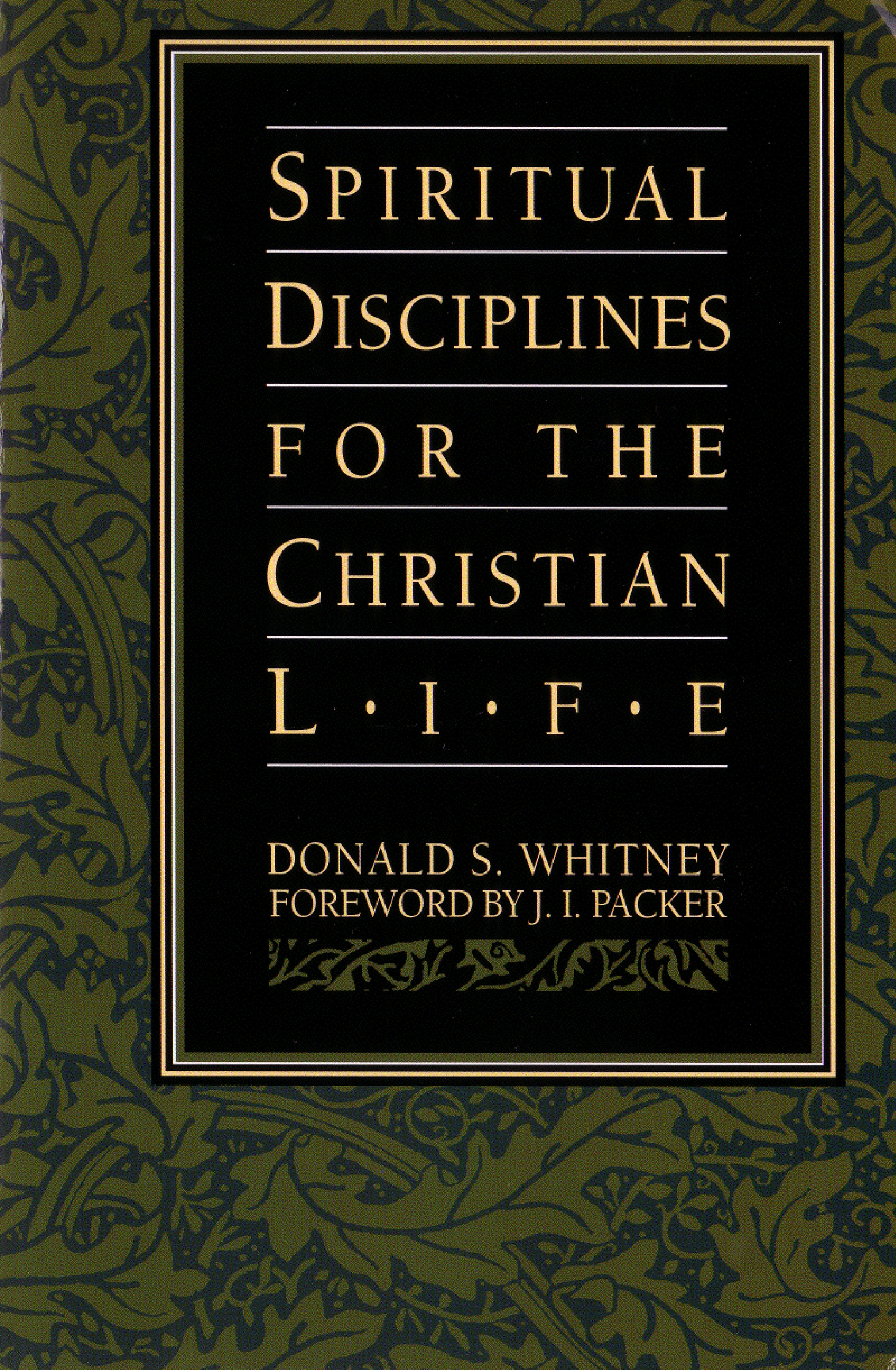
 Title: Spiritual Disciplines for the Christian Life
Author: Donald S. Whitney
Publisher: NavPress, 1991; 254 pp. $15.99
Recommendation (4-star scale): 
“The Christian ideal has not been tried and found wanting,” wrote G. K. Chesterton. Rather, “It has been found difficult and left untried.”
This could not only be said of the Christian life in general, but the spiritual life and spiritual disciplines in particular. Many believers struggle to maintain a consistent life of devotion in the disciplines and only find themselves repeatedly defeated and before too long, they quit the practices all together, despairing that they will “never be able to get my life together.”
As an aid to stimulating believers to a more consistent and disciplined life of fellowship with God, Donald Whitney has written Spiritual Disciplines for the Christian Life. This topic is familiar to Whitney who has also written the very helpful Ten Questions to Diagnose Your Spiritual Health and Simplify Your Spiritual Life. He also maintains a website — The Center for Biblical Spirituality — that is filled with many helpful resources.
In this book, Whitney addresses in very practical ways the “how to” of each discipline, writing in a very readable and understandable way. Among the topics he addresses are:
- Bible intake (reading, meditation, and study)
- Prayer
- Worship
- Evangelism
- Serving
- Stewardship
- Fasting
Additionally, he considers other topics that may not be as firmly rooted in Scripture as things like Bible reading and study, prayer, and evangelism:
- Silence and solitude
- Journaling
- Learning
Of particular help are his first chapter, “The Spiritual Disciplines…for the Purpose of Godliness,” and the last chapter, “Perseverance in the Disciplines.” With these chapters he is careful to delineate the purpose of the disciplines and the difficulty in maintaining them.
In chapter one he focuses the reader’s attention on these disciplines by writing, “The Spiritual Disciplines are the God-given means we are to use in the spiritual pursuit of Godliness.” And, “Think of the Spiritual Disciplines as ways we can place ourselves in the path of God’s grace and seek Him much as Bartimaeus and Zacchaeus placed themselves in Jesus’ path and sought Him.…The Spiritual Disciplines then are also like channels of God’s transforming grace.” And, “Discipline without direction is drudgery. But the Spiritual Disciplines are never drudgery as long as we practice them with the goal of Godliness in mind. If your picture of a disciplined Christian is one of a grim, tight-lipped, joyless half-robot, then you’ve missed the point. Jesus was the most disciplined Man who ever lived and yet the most joyful and passionately alive. He is our Example of discipline. Let us follow Him to joy through the Disciplines.”
This theme of discipline as a means of the pursuit of God and godliness runs throughout the book and is considered carefully with each topic. For instance, in writing about fasting, he says,
Not only can fasting express repentance, but it can also be in vain without repentance. As with all Spiritual Disciplines, fasting can be little more than a “dead work” if we have persistently hardened our hearts to God’s call to deal with a specific sin in our lives. We must never try to immerse ourselves in a Spiritual Discipline as an attempt to drown out God’s voice about forsaking a sin. It is a perversion of fasting to try to use it to balance self-punishment for a sinful part of life we want to continue feeding.
In other words, fasting (or any other discipline) is a benefit only as it is a quest to use that practice as a means of being transformed increasingly into the likeness of Christ. When we use discipline to intentionally and hypocritically cover known sin in our lives, it has no benefit for us.
Similarly, in the final chapter he speaks directly and honestly about the difficulty of continuing in the disciplines:
Without practicing the Spiritual Disciplines we will not be Godly, but neither will we be Godly without perseverance in practicing the Disciplines. Even a slow, plodding perseverance in the Spiritual Disciplines is better than a sometimes spectacular but generally inconsistent practice.…
There are no shortcuts to Godliness.…So if you are simply waiting until you have more time for the Spiritual Disciplines, you never will.…Because life never really settles down, because we will always have plenty of things to do, if we are ever going to make progress in Godliness through the Spiritual Disciplines it must be done when life is like it is now.
And the benefit of Whitney’s book is that it is full of helpful hints and ideas on how to make it work “when life is like it is now.”
Weaknesses of the book? A couple. The first half to two-thirds of the book is stronger than the latter portion because late in the book he addresses topics that are not explicitly commended in Scripture as disciplines themselves (i.e., they are not commanded), but seem to be more like derivatives of the actual disciplines. For instance, silence and solitude are not commanded (and probably not even directly commended), yet if one is going to be faithful to study and meditate on Scripture, silence and solitude are necessary. Consequently, the final topics he covers (silence and solitude, journaling, and learning) seem to be based more on anecdote than Scripture.
Additionally, in places he seems to rely specifically on a couple of writers who are much more mystical and less theological in their approach to Scripture. I wonder if he was writing this book today instead of 20 years ago if that would still be the case.
And I have a few questions about his chapter on fasting. While he provides a good survey of the Biblical uses of fasting and the purposes of fasting, he draws most of his examples from the Old Testament, and makes the assumption that they are all equally valid for believers in the church age. I’m not convinced that his applications are valid. And he does not address the question of why the last occurrence of the word “fast” is in Acts 27:9 — if fasting is for the NT church, why are there no references to it in the Epistles? That’s not to say unequivocally that it doesn’t have to be done, but it is significant that it isn’t addressed or even mentioned in any of the Epistles.
These small reservations aside, the book is still very helpful, and undoubtedly the best book on the spiritual disciplines in print. Not only do I recommend it. I recommend the reader practices what Whitney preaches. It may be difficult, but it is eternally worthy of our efforts.
 Words of Grace