
A few weeks ago, the city of Fort Worth created quite a stir when four city buses began carrying an advertisement from the Dallas-Fort Worth Coalition of Reason stating, “Millions of Americans are Good Without God.” [Fort Worth Star-Telegram.]
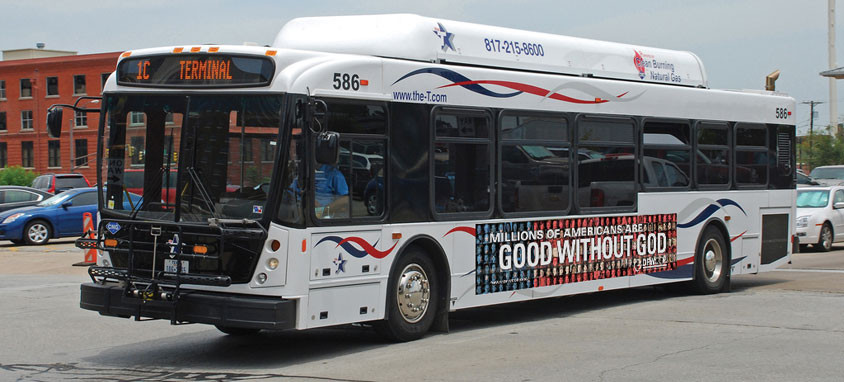
Negative response to the advertising campaign led to the city quickly deciding that no buses would be allowed to bear ads with religious themes. But the question remains, can a man be good without God?
I thought about that again this morning when I retrieved my newspaper from the driveway and was greeted by this headline: “Obama to those at service: ‘We can be better.'” His full statement at the Tucson memorial is as follows:
The loss of these wonderful people should make every one of us strive to be better in our private lives – to be better friends and neighbors, co-workers and parents.…
I believe we can be better. Those who died here, those who saved lives here – they help me believe. We may not be able to stop all evil in the world, but I know that how we treat one another is entirely up to us. I believe that for all our imperfections, we are full of decency and goodness, and that the forces that divide us are not as strong as those that unite us. [NY Times]
He also said that there were many things for which we could be thankful in the midst of this tragedy — for the selflessness of those who responded to the needs of the injured at the scene, for those who apprehended the shooter, for medical professionals who worked tirelessly to treat and attempt to save the wounded and dying. He’s right. We can and should be thankful for those things and more. But do those reasons for gratitude rightly translate into the premise that we can be better (i.e., more moral, more righteous) in our actions and motives? Or, to question the slogan on the bus: can we be good without God?
These two suppositions are not unique. Much of the foundation of various mental health treatment centers is based on this position: we can do better and be better. A whole arm of the “church” is based on the premise of avoiding divisive talk about sin and instead focusing on the good we can and might do for others. In our culture we celebrate and honor those who “pick themselves up by their own bootstraps.” The image is ludicrous, and yet we celebrate it. And we even tell our young children, “You can do and be anything you want to be!” (Have we ever told them a bigger lie?)
So let’s briefly consider the idea that we can be better and do good without God.
Scripture makes clear that there is no one good:
as it is written, “There is none righteous, not even one; there is none who understands, there is none who seeks for God; all have turned aside, together they have become useless; there is none who does good, there is not even one.”
“Their throat is an open grave, with their tongues they keep deceiving,” “the poison of asps is under their lips”; “whose mouth is full of cursing and bitterness”; “their feet are swift to shed blood, destruction and misery are in their paths, and the path of peace they have not known.”
“There is no fear of God before their eyes.” (Rom. 3:10-18)
That passage doesn’t leave too many loopholes, does it? It’s clear and unambiguous: in himself, man is not good. What he does, he does not do out of love for God. He does not love or fear God, so he cannot be good and cannot do good.
Of course, many will say, “Oh, but many people do good things for others: they are in helping professions (doctors and nurses and counselors and pastors and civic organizations and the like), they change tires for stranded motorists and contribute to food drives and give hours to Habitat for Humanity and serve in the military and take their grandchildren for ice cream cones and even give money back to a cashier when they receive too much change. Many people do good.
Well, just glancing at it superficially, you would think so. Except there is a standard that is greater than just man’s superficial activity. Here it is: “Whether, then, you eat or drink or whatever you do, do all to the glory of God” (1 Cor. 10:31). The reason that all those things are not good is that for an unbeliever, they are not done for the glory of God — they are not done to honor and exalt Christ, they are not done as an expression of Spirit-produced worship and delight in the Father. And because of that, it is also said that “all have sinned and fall short of the glory of God” (Rom. 3:23). No one on his own achieves that standard of God’s glory, so no one does good.
Jesus also affirms this when He says that only God is good (Lk. 18:19) — and that excludes every man from being good. Further, if goodness is the test, then perfection is the standard — to be counted as “good,” we must be as good as God. We must be perfect (Mt. 5:48). Of course that’s impossible. No one is absolutely perfect in all his actions or motives. So it is impossible to be good without God (Mt. 5:48).
Now that does not mean that you are as bad as you could be; certainly you could sin more horrifically. But let’s also say that another way: Just because you are not as bad as you could be does not mean you are good. The standard of goodness is not “I’m not completely bad,” or “I’m not as bad as I used to be,” or “I’m not as bad as the person ________ .” No, the standard of goodness is God’s standard of goodness, which, again, is perfection. So man cannot be good without God and man cannot get better on his own.
Al Mohler was absolutely correct when he wrote a number of years ago that the problem that sinful man has is that he thinks the solution to his problems are within himself (which is also what the ad on the bus and the presidential speech imply):
Most Americans believe that their major problem is something that has happened to them, and that their solution is to be found within. In other words, they believe that they have an alien problem that is to be resolved with an inner solution. What the gospel says, however, is that we have an inner problem that demands an alien solution — a righteousness that is not our own. Once we begin to understand how that dichotomy comes together, we can see better how we can think we are talking about the gospel, yet people in this culture will hear it as merely a new form of therapy.
We cannot fix ourselves. We cannot be better. We cannot be good. Not without God. The only way we can be and do good is through the imputation of Christ’s righteousness to us. The only way we can obey God and be gracious and kind and loving is through the transformation that comes through the gospel. The only way our culture is changed and people genuinely serve each other in kindness and grace is through the gospel. The only hope for avoiding more instances like the tragedy in Tucson is not for men to try a little more conscientiously to be good, but for men to respond to the gospel.
So, to transform the bus and presidential statements, yes, we can be good and yes, we can do better, but we will only do good and be better when we submit ourselves to the gospel and lordship of Jesus Christ.
 Words of Grace