
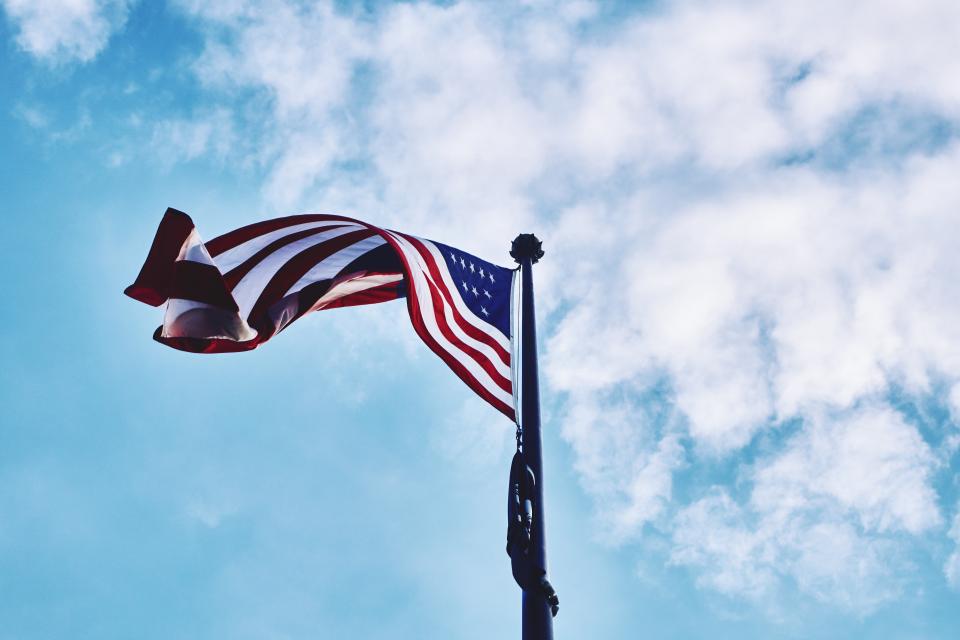
All day Tuesday American flags were flown, songs were sung (how many times did you hear “God Bless the USA” or “America the Beautiful?”), hot dogs and hamburgers were consumed, parades were held, and as an exclamation on the day of rejoicing in liberty, fireworks were set off.
Tuesday was a day of freedom.
Yet many of the celebrants of freedom were in bondage (though they were unaware). Though free to eat hot dogs and free to purchase and light fireworks and free to gather with family and friends, they were still enslaved to and under the condemnation of their sin. While celebrating freedom, many were guilty (Rom. 3:10-18, 23) of both indwelling and practiced sin (Rom. 5:12). And the consequence of the guilt is the same for all — no matter what the sin is, the judgment is death (Rom. 6:23).
But not all are guilty. Some have been set free. So Tuesday was a double celebration for those of us who are in Christ — free to enjoy the liberties established by the founders of the United States, and even more free (eternally!) to enjoy the delights of Christ and freedom from the enslaving power of sin.
Paul affirmed that reality in Romans 8:2 —
For the law of the Spirit of life in Christ Jesus has set you free from the law of sin and of death.
The believer (“you”) has been “set free!” The freedom Paul has in mind is a freedom from enslavement. It’s the same word he used in Romans 5:1; 6:18, and 22. It’s the same word Jesus used in John 8:32, 36. The believer is no longer trapped, in bondage, or enslaved to sin. Sin no longer has hold over the believer (the believer is no longer compelled to sin in everything; he can say “no” to sin and “yes” to obedience to Christ).
And notice that Paul says this freedom is something that has happened. It’s a completed act of God for us. We have already been granted emancipation from slavery to sin. The irrevocable document liberating us has been sealed with the name and blood of Christ.
This doesn’t mean the believer won’t sin (Romans 7 and Galatians 5 make it clear we will still sin), but it does mean that sin is not the master over the believer; but Christ is the new master.
Paul also clearly says that the believer has been set free “in Christ.”
I was pondering this phrase several years ago while in the dentist’s chair (Romans is a good distraction from what’s going on with your teeth!) and I realized there is a parallel between v. 1 — “there is no condemnation in Christ Jesus” — and v. 2, “there is freedom in Christ Jesus.” It seems that Paul is saying the lack of condemnation that those who are in Christ have is because of the freedom that was accomplished by Christ. We are not only unified with Christ, but our union with Christ has broken our former bonds with sin and set us free. As Jesus said (Jn. 8:32), we are free indeed!
Further, we are set free “from the law of sin and death.”
The word “law” is not a reference to the Mosaic Law, obviously. It probably has the sense of “principle” or “authority” as it did in Romans 7:21. This law is the same thing as “the law of sin” in 7:23, 25. This is a law that is different from the Law of God and opposed to the Law of God. When Paul calls sin and death a “law” he means there is a part of sin that is compelling to the human being. The flesh “dictates” action. The flesh doesn’t just entice us to sin; the flesh pushes us to sin and manipulates us to sin. It is a controlling principle.
And the believer in Christ has been set free from that controlling power. As one commentator says, “The last word is not with sin or with death. While believers are not sinless, they have real liberation in Christ Jesus.” [Morris]
One important question about this freedom is, “Just how were we set free?” Paul answers in the first clause of the verse: it was “the law of the Spirit of life” that set us free.
What is this “law” of the Spirit? Just as “the law of sin and death” is not a reference to the Mosaic Law, this law of the Spirit is not the Mosaic Law either. It is best to understand the Spirit’s law also as a reference to a principle, force, or authority. The Spirit’s law is the compulsion and authoritative working of the Spirit that produces freedom in us. Likely Paul has something very similar in mind as he did in Romans 7:6 — as believers in Christ, we don’t live under the authority of the Law of Moses, but we live under the authority of the Spirit. The Spirit constrains and compels us and produces life in us.
All that the Spirit is and all that He does is in contrast to the death that comes from being in Adam and under the law and under sin. The Law only condemns; sin always and only brings death. Sin is never life-giving; it is always life-taking.
But the Spirit counteracts everything that sin is. The Spirit always comes with life; the one who is in the Spirit is never condemned and never dead and always alive and living.
The one who is in Christ has the Spirit and has the work of His might and right! He is genuinely, truly, actually, and really free. And that’s a truth to celebrate and enjoy on July 4 — and every day of every year. If you are in Christ, you are free.
“American Flag” by Alexey Topolyanskiy/ CC0 1.0
 Words of Grace