
Being finite, created beings, we understand that some biblical and theological realities are beyond our comprehension. While God has revealed them to us as true, we cannot grasp the full meaning behind the words.
Such is the case with the crucifixion of the Son of God by the Father of God. How can the Father bear the sword of His judgment against the Son and strike Him so that He is put to death (Zech. 13:7)? How could the Father strike, smite, afflict, and pierce the Son for our sins (Is. 53:4)? How could the Father be pleased to crush the Son and afflict the second member of the Trinity with the grief of death (Is. 53:10)? Similarly, how could the Father find good pleasure in making peace with sinful men through the shed blood of His Son on the cross (Col. 1:19-20)? And how could the Father design and implement a plan through His sovereign predestination to crucify His Son (Acts 2:22-23)?
Those are all realities revealed about the nature of the Father and the Son in the Scriptures — and we feel a seeming contradiction in those statements. It does not seem loving for a father to treat a son in that way; and it all-the-more doesn’t seem loving for the triune Father to treat the triune Son that way.
Yet if sinners would be redeemed, it took such a plan. And if redeemed sinners would exist to forever delight in and exalt the Son, then it took that plan to accomplish the needed redemption.
John Piper is helpful in explaining this confounding (to us) plan of God:
Why did God bruise his Son and bring him to grief? He did it to resolve the dissonance between his love for his glory and his love for sinners. We get a glimpse of this in Isaiah 53:6: “All we like sheep have gone astray; we have turned every one to his own way; and the LORD has laid on him the iniquity of us all.” Notice two things. Again (as in verse 10) it is the Lord who is at work: “The LORD—God the Father—has laid on him the iniquity of us all.” And then notice that the issue is iniquity, which is just another word for sin. “The LORD has laid on him the iniquity of us all.” The Son was bruised because God-dishonoring sin could not be ignored. And why couldn’t it be ignored? Why couldn’t God just let bygones be bygones? Because God loves the honor of his name. He will not act as though sin, which belittles his glory, didn’t matter. It cannot simply be swept under the rug of the universe, as though nothing awesome were at stake. The judge of all the earth will do right (Genesis 18:25). He will judge the world in righteousness (Psalm 9:8).
So God the Father makes an agreement with his Son that he will demonstrate to all the world the infinite worth of the Father’s glory. How? By taking the punishment and suffering that our sin deserved. Isaiah 53:5 makes the substitution even more explicit: “He was wounded for our transgressions, he was bruised for our iniquities.” Similarly verse 12 says, “He bore the sins of many, and made intercession for transgressors.” And verse 8 says he “was stricken for the transgression of my people.” Verse 9 makes plain that the bruising was not because of the Son’s own sin: “And they made his grave with the wicked and with a rich man in his death, although he had done no violence, and there was no deceit in his mouth.”
It was not for his own sin that the Father bruised the Son. It was because he wanted to show us mercy. He wanted to forgive and heal and save and rejoice over us with loud singing. But he is righteous. That means his heart was filled with a love for the infinite worth of his own glory. But we were sinners. And that means that our hearts were filled with God-belittling affections. So to save sinners, and at the same time magnify the worth of his glory, God lays our sin on Jesus and abandons him to the shame and slaughter of the cross. [The Pleasures of God.]
How terrible must sin be to exact such a punishment from God against His Son — a punishment that is righteous and not retributive? God was delighted to bruise, use the sword of justice, and strike His Son so that His justice would be fulfilled and through that appeased justice present to His Son an eternally pure bride that would forever glorify and honor the Son.
How gracious must the Savior be to endure such a punishment from His Father to redeem His enemies and make them His friends? The Son was pleased to offer Himself as a sacrifice to God so that God’s name would be most glorified through the reconciliation of sinners who believed in Him.
How beyond comprehension must God be that both Father and Son were pleased to endure the temporary and fleeting darkness of the cross so that they would bring about the eternal joy of union with us, for their glory? That’s the redemption that was done through the suffering Shepherd.
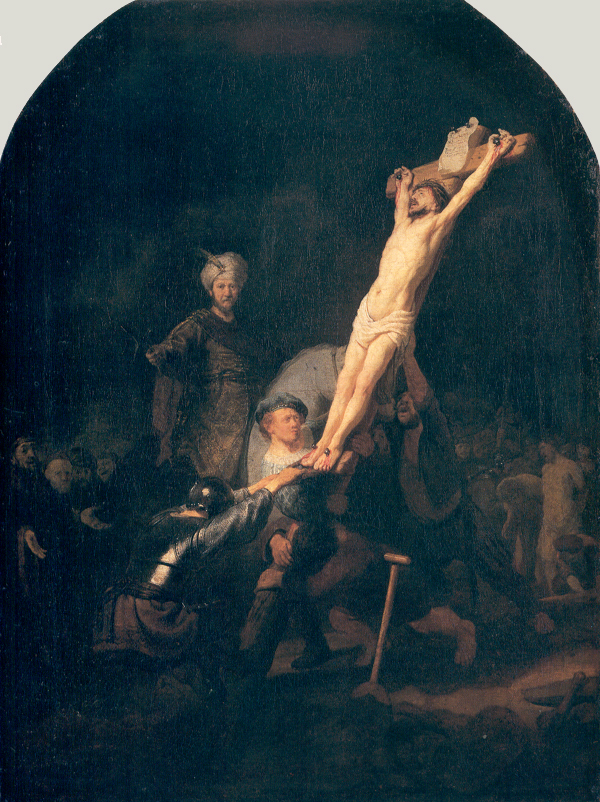
Rembrandt, “Raising of the Cross,” Public domain, via Wikimedia Commons.
 Words of Grace
