
The Forerunner of the Son of Man
Luke 1:13-17
July 7, 2024
Every child wants to believe his dad is a hero; but John Cromwell Jr.’s father really was a hero. A Navy Captain, John, Sr. died in 1943 in his submarine off the Gilbert Islands in the south Pacific. His submarine was one several that was in a line that sustained significant damage from Japanese depth charges as they prepared to attack a Japanese stronghold. Cromwell surfaced his submarine to enable his crew to abandon ship. A firefight with the Japanese ensued and the submarine was badly damaged, and Cromwell rode it to the bottom of the sea and his grave.
It’s a hero’s story, and Cromwell received a posthumous Medal of Honor for his bravery. But something didn’t add up to John Jr. — and especially after he also joined the Navy. “I never could buy that original story,” he said. “Once I got on active duty, and I saw how things went, it didn’t seem like that was that big of a deal that he would have had to give up his life for it.” Then he learned the rest of the story…
…by late 1941 Navy cryptologists had deciphered the Japanese naval code, and senior officers were reading decrypted enemy messages.
As a division commander, Cromwell was privy to this highly classified intelligence, code-named ULTRA, his son said. He also happened to be close friends with one of the people who helped crack the code.
If the Japanese knew the code was compromised, they would have changed it and made it more difficult for the U.S. Navy to track their vessels.
When information about ULTRA eventually came to light, the son said that it “all came together.” It was this secret that his father died to protect.
“It was probably the biggest secret of the war,” he said. “And even when the citation was written up, it was still top secret. So in his citation, they waffled and didn’t give the true facts or the reason he went down. He knew the code was broken.” [WSJ, 5/26/23]
He had trouble with the story because he didn’t know the full story. And when the full story was revealed, then he was especially grateful for his father’s service and bravery. The full story gave him understanding.
As we wait for God to answer our prayers, we sometimes think He is distant, or uncaring (even aloof), or unwilling to answer. We don’t know the realities of what He is doing to bring about His plan. He is answering our prayer, and He is acting on our behalf. We just can’t see it yet.
That is what Luke is doing with the story of the forerunner to Jesus, the Son of Man. He is telling us that while there were 400 years of silence, God is acting and has been acting. He is pulling back the curtain so we can see the backstory of Christ’s birth and see the gracious working of God. That backstory gives us confidence about Christ’s story (which is its primary intent), but it also stimulates confidence for our story.
Because God is always acting graciously, do not fear.
In short, this is a story of God’s grace. It’s a story about answered prayer for Zacharias and Elizabeth, and it’s a story of the ministry of John the Baptist, but supremely it is a story about how God is orchestrating the advent of Christ — and in that way, it’s a story of grace. And it is a reminder that even when we can’t obviously see it, God is acting graciously in our lives. And because of God’s grace, Zacharias (and we) should be peaceful and not fearful. In this story, see four aspects of God’s grace:
- The Promise of the Forerunner (v. 13)
- The Joy over the Forerunner (v. 14)
- The Power for the Forerunner (v. 15)
- The Ministry of the Forerunner (vv. 16-17)
Download the rest of this sermon on Luke 1:13-17.
The audio will be posted on the GBC website by Tuesday.
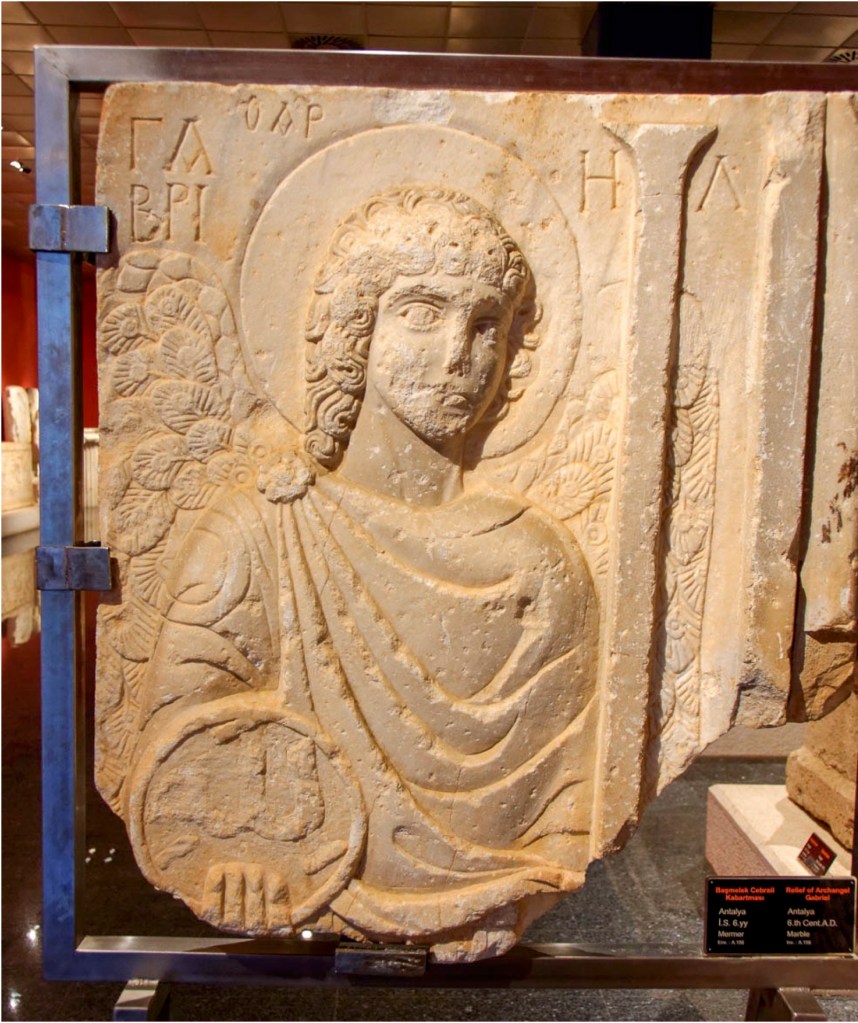
Relief of Angel Gabriel, Byzantine, 6th C. AD. @ Bible Places.
 Words of Grace
