
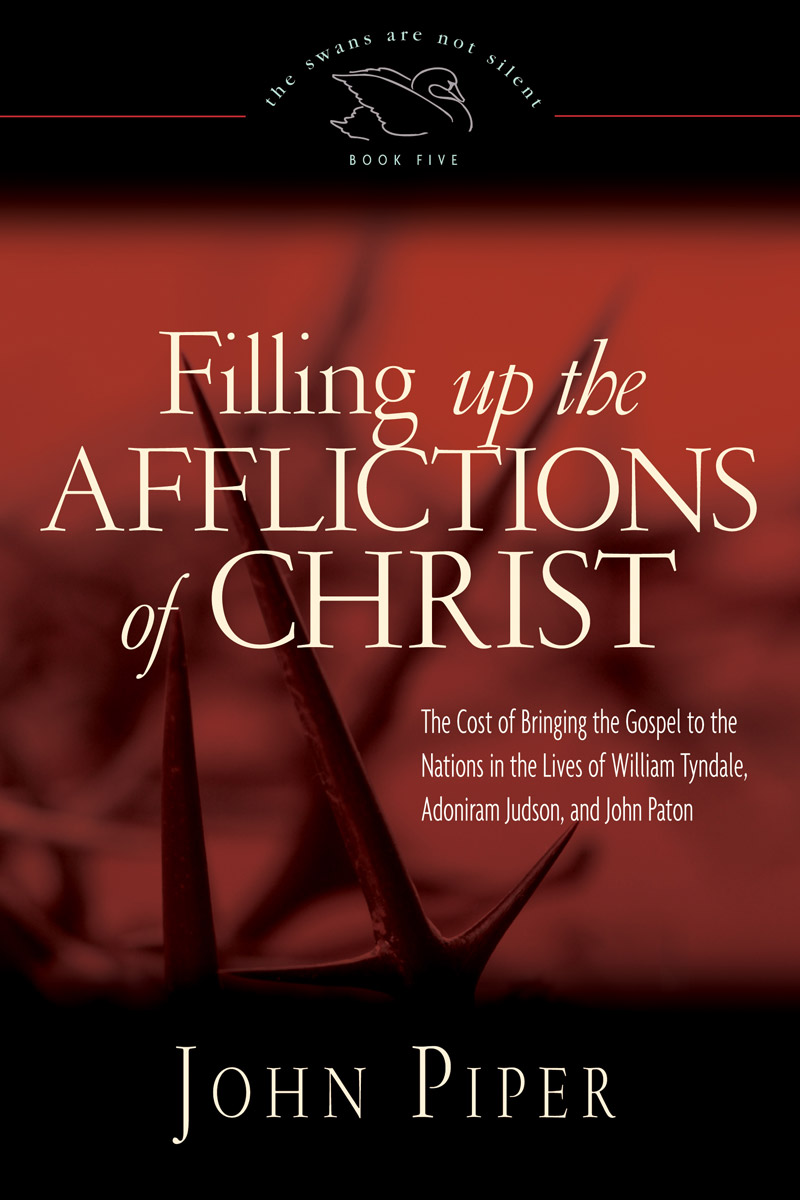
Author: John Piper
Publisher: Crossway, 2009; 126 pp. $17.99
Recommendation (4-star scale): 
In college and seminary I had very little affinity for history or biography. Now I naturally seem to gravitate pretty regularly to those kinds of books. In part, this desire is part of some natural curiosity on my part — what was it like when…? And some of it is a quest to be encouraged by the examples of others who have gone through trial and trouble and maintained a faithful life for Christ.
And of all the biographies and historical works I’ve read, John Piper’s biographies in “The Swans Are Not Silent” series are consistently among the best. They are well-written and researched, concise, and theological. And that last point is what particularly makes them helpful books — Piper always draws the theological and Biblical lessons of people’s lives that made them effective servants of Christ.
This latest edition is another fine example in this series, and in fact may be my favorite of these books.
The intention of the book is to demonstrate how God uses (intentionally designs) suffering for evangelistic purposes:
More and more I am persuaded from Scripture and from the history of missions that God’s design for the evangelization of the world and the consummation of his purposes includes the suffering of his ministers and missionaries. To put it more plainly and specifically, God designs that the suffering of his ambassadors is one essential means in the triumphant spread of the Good News among all the peoples of the world.…God’s plan is that his saving purpose for the nations will triumph through the suffering of his people, especially his frontline forces who break through the darkness of Satan’s blinding hold on an unreached people.
This book looks at the lives of three men who suffered much, resulting in significant gospel propagation: William Tyndale who was burned at the stake for translating the Bible into English, John Paton, who took the gospel to the New Hebrides amid much opposition to his task, and Adoniram Judson who went as a missionary to Burma and suffered great physical ills (burying two wives and a child in addition to his own frequent pains).
So was the cost worthwhile? Was it beneficial to them and to the gospel to endure such suffering?
Not to ruin the end of the story, but the Bibles most of us pick up to read every day are based largely on Tyndale’s translation — about 84% of the King James New Testament and 76% of the King James Old Testament is Tyndale’s translation. Paton went to a nation that knew nothing of the gospel and was even cannibalistic — and today over 91% of the population identifies itself as Christian (though a much smaller amount would be considered evangelical). Judson’s labors were similarly in a country where the gospel was unknown, yet today that same country now boasts some 3700 Baptist churches with over 600,000 members.
Was it worth the cost? Was it worth the suffering and ostracism and loneliness and death that came to these men and their families? It was.
And that message of the blessing that comes from faithful sufferers and martyrs is a message our comfortable American church needs well to hear and heed today:
How likely is martyrdom today? How important is suffering for the sake of taking the gospel to the nations? George Otis Jr. shocked many at the Second Lausanne Congress on World Evangelization in 1989 when he asked, “Is our failure to thrive in Muslim countries owing to the absence of martyrs? Can a covert church grow in strength? Does a young church need martyr models?…can the Muslim community take seriously the claims of a Church in hiding?
This is not to say that there is never a time to flee and that the church must always be pointed towards martyrdom (Piper includes a brief and helpful discussion of when to flee and when to stay, and gives examples of both from the lives of these three men). But it is worth asking if we have overvalued comfort and peace to such an extent that our failure to suffer well has lessened the impact of the gospel (both overseas and in America).
This is an excellent book — both as an encouragement to reconsider our perspective of suffering, and as a stimulant to see our suffering and death in the context of being used for the advance of the gospel. And that’s why this is not only a good book for you to read, but it is an excellent book to give your teen- and college-age children and friends. Let them, at the beginning of their walk with Christ think it a natural thing to suffer well so the gospel might be advanced.
 Words of Grace