

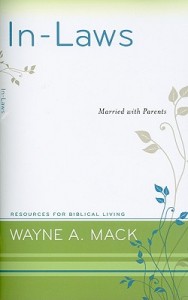
 Title: In-Laws: Married with Parents
Author: Wayne Mack
Publisher: P & R Publishing, 2009; 48 pp. $4.99 (available in the GBC bookstore for $3)
Recommendation (4-star scale): 
I have dozens of books on marriage and many more on men’s and women’s issues — how a man can be a godly husband and lead his wife in that godliness. I have counseled numerous couples prior to their marriages and I have counseled many couples after marriage. I suppose I have seen and heard about just about every kind of marital problem there might be and have done reading to help me be a better and wiser counselor on all those issues.
Yet the issue of how adult children relate to their parents (and conversely, how parents relate to their adult children) is still a topic I am waiting to find a book that is of conclusive help. This brief work by Wayne Mack is the first step in correcting that problem.
In another of the series of helpful topical booklets published by P & R, Mack addresses a topic that is widely talked about yet rarely written about. And though brief, the booklet has merits and is helpful.
Mack demonstrates how the “one flesh” principle in Genesis 2 is the foundation of a marriage relationship and all the corollary relationships that flow from the marriage. And because the marriage relationship is first, all other relationships — including children, parents, and in-laws — are secondary. This basic premise guides everything he says about the in-law relationship.
He then offers a number of “put off” principles for couples — unwise and sinful habits that they might have begun with their in-laws that will help them have God-honoring relationships with their parents- or children-in-law. As an example, he explains how young couples should “leave behind an inordinate dependency on their parents when they get married.”
In addition, he provides a number of positive “put on” principles that both parents and children can adopt to increase the likelihood of healthy relationships. For instance, he says, “Children must put on the determination to make their mate, rather than their parents or anyone else, the most significant human being in their lives.”
Perhaps the most helpful portion of the book is the “Practical Guidelines” section in which he provides numerous suggestions for both children and parents for how they might relate to one another. In conjunction with these ideas he also has a number of exercises in the appendices that couples will find helpful — particularly if they have never thought constructively about how to handle in-law difficulties.
The final appendix is not written by Wayne Mack, but by Lou Priolo, who offers, “Practical Considerations for Resolving In-Law Conflicts.” In other words, “what to do when things go terribly wrong.” Again, though brief, this section is helpful and beneficial — a first step to a couple that is in the midst of difficulties.
For a topic that has been written about far too rarely, this booklet is a good start to getting help. Now I just await a book-length treatment of this topic by the same author for even more help for struggling relationships.
 Words of Grace