
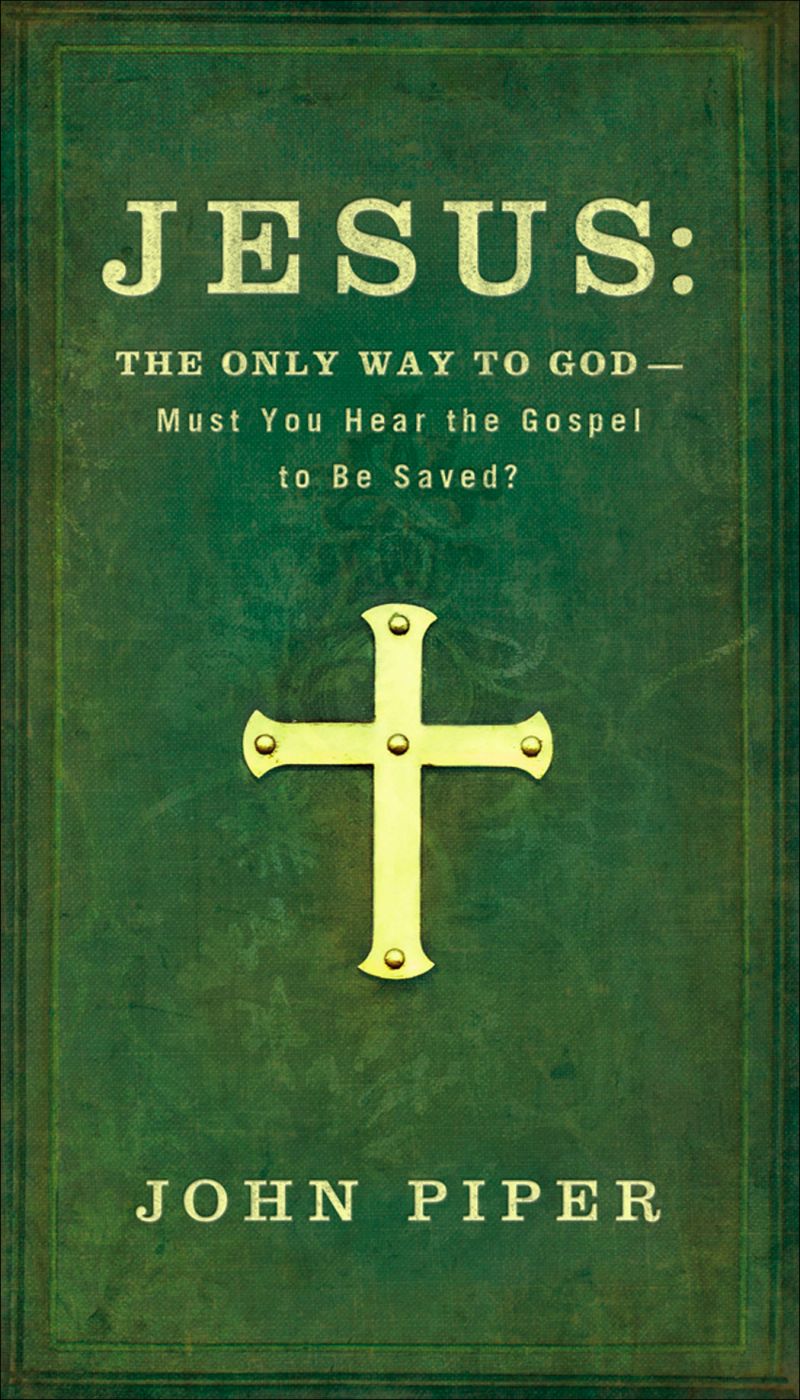
 Title: Jesus: the Only Way to God
Author: John Piper
Publisher: Baker, 2010; 123 pp. $5.99
Recommendation (4-star scale): 
The gospel is always under attack.
Recently I read this statement — from someone who for many years was considered to be in at least the same corridor of conservative evangelicalism, if not in the classroom as a teacher: “In recent years I have become aware of a way of presenting the gospel invitation that troubles me.…I have heard people say this: ‘In order to be saved you must believe that Jesus died on the cross.’…Whenever I hear that nowadays, I get extremely uncomfortable.”
Unfortunately, this sentiment is no longer unusual or rare. And in God’s grace, this new book by John Piper, Jesus, the Only Way to God: Must You Hear the Gospel to be Saved? addresses that faulty understanding of the gospel.
Though short in length, Piper addresses three fundamental questions about Christ and the gospel:
- Will anyone experience eternal, conscious torment under God’s wrath? This one question addresses the two objections against hell’s existence, of universalism and annihilationism.
- Is the work of Christ necessary for salvation, or are there other bases? This question addresses the attacks of pluralism against the singular claims of Christianity.
- Is conscious faith in Christ necessary for salvation? Here Piper addresses the views of inclusivism, answering affirmatively the question, “Is it necessary for people to hear of Christ in order to be eternally saved?”
It is necessary to answer these questions. Heaven and hell hang in the balance. And as Piper notes,
…there is no such thing as a “mere” escape from hell. Rescue from the worst and longest suffering can only be called “mere” by those who don’t know what it is, or don’t believe it’s real. But implicit in the rescue from hell is the experience of praising God forever, and loving people forever, and enjoying creation forever, and creating beauty forever.
So yes, it is important to answer these questions for the significance of the questions alone. Yet it is also important to answer the questions rightly because our motivation to do missions and evangelism also hang in the balance. If universalism or annihilationism or inclusivism are right, then there is no urgency to the gospel. Why be concerned for unredeemed masses because they will eventually be saved or annihilated. Or why let the gospel be divisive because ultimately the faith one follows is irrelevant for all roads lead to the same position in heaven.
But if those presuppositions are wrong (as Piper demonstrates from Scripture so superbly that they are wrong), then there is great urgency to the clear, true, biblical gospel:
Without this faith — faith resting consciously in Jesus as he is presented in the gospel — there is now no salvation.…
…the more likely it is that people can be saved without missions, the less urgency there is for missions.
So with all three of these questions, there is much at stake. Nevertheless, in the end it is not our desire to maintain the urgency of the missionary cause that settles the issue, but: What do the Scriptures teach?
In other words, we strive to get the gospel right because the church has been positioned by God as the pillar and support of the truth — it is our responsibility to guard, protect, and keep the truth of God and the gospel that has been handed to us. And this book equips us to do that very thing.
It is important for believers to get the gospel right. It is our message. It is the only means by which anyone will ever escape hell and be enabled to enjoy God. Read this book to understand the importance of this gospel.
 Words of Grace