
In a recent sermon I mentioned that I think about death regularly — daily.
I think about my age and the reality that I am in the last third/quarter of life (at most). I think about my death because of the recent invitation that the Social Security Administration sent me to begin drawing funds from them. I am aware that I am older than my mother-in-law when she died and within three years of my mother’s age when she died. I am not “old” and I don’t feel old, but I am aware of my accumulation of years and the inevitable end of my years.
I think about friends whom I have buried and I think about the potential for attending the funerals of other friends and family and about guarding my heart from regret, despondency, or despair.
I think about the death of Christ. I am compelled to think of Christ on the cross more than daily because more than daily I am dependent on His work on the cross to wash away the debt of my sin. More than daily I need His cross work to restore my fellowship to Him and the Father. More than daily I need the power He exhibited at the cross to empower me for living in freedom from the flesh and the bondage of sin. More than daily I need the wisdom, gifting, and power of the Spirit who is given as a gift by Christ because of His work on the cross.
When I think about my death, I am reflective — am I leaving a legacy that will honor the Lord and be an encouragement and provide direction for my family?
When I think about the deaths of dear friends and family, I am grateful and grieved. I lament the loss of regular fellowship and the ongoing awareness of loss (they are no longer part of my daily life). I shed tears at the funeral and graveside and even afterwards in the quiet of my contemplation. Yet I am also thankful for the privilege of those relationships and the privilege of the fellowship we have shared and the gift of influence they had in my life — and even how their influence continues to shape me.
When I think of the death of Christ, I am sobered. The gift of the incarnation is beyond my comprehension; how is it that the Lord of Glory could become genuine man? The death of the Lord of Glory on the cross is an even greater mystery. God dies? The eternal One is subjected to death? The Son of God receives the wrath of His Father, though He was sinless both in Glory and on earth and had done nothing worthy of the Father’s wrath? And how awful must the wrath of God be for the Son to cry out, “My God, My God, why have You forsaken Me” (Mt. 27:46)? Such sober contemplation is helpful to comprehend the magnitude of Christ’s obedience to the eternal plan of the Trinity and His sacrifice for us.
Yet remembering the cross is not just a sober (or grievous) experience for the believer. It is also joy. Yes, the worst and most unjust (from a human perspective) death ever experienced is joyful. Christ’s death is joy for us because it was joy for Christ (Heb. 12:2). It was joy for Him because He knew what the cross would accomplish and that He would be accepted in Heaven to resume His place at the throne of God as co-regent of all things. The cross is joyful because it is the means by which we perishable ones put on immortality and the imperishable body, and the cross is the source of the removal of death’s stinger (1 Cor. 15:50-58). The cross is joyful because it is the source of our liberty from sin and death (Romans 6). The cross is joyful because it is the means of fellowship with God that will be realized in the next age (after death, Lk. 22:15-16; Rev. 19:7-9) — because of the terribleness of the cross, there is a the confidence of the greatness of freedom from sin now and eternal and unimaginable delights later.
So as you contemplate death today —and as you contemplate Christ’s death — be sober about the cost and the reality of His death. And be joyful with the kind of joy Christ had on the cross, and delight in all the abundant provisions of the cross for us.
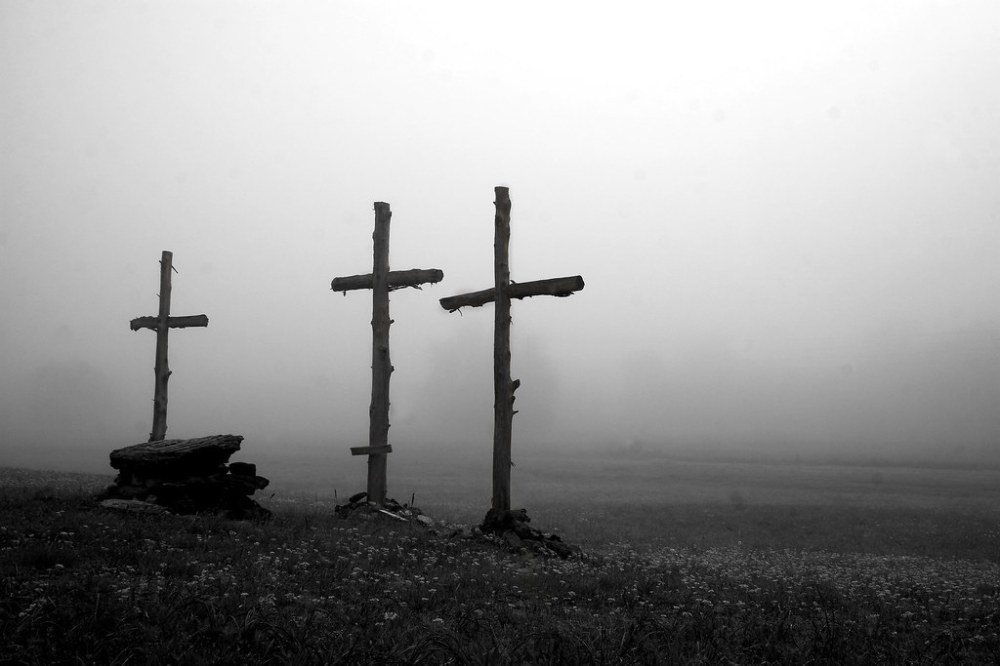
“The Crosses on Good Friday” by 50%ChanceofRain is marked with CC BY-NC-ND 2.0.
 Words of Grace