
“There are two equal and opposite errors into which our race can fall about the devils. One is to disbelieve their existence. The other is to believe, and to feel an unhealthy interest in them. They themselves are equally pleased by both errors and hail a materialist and magician with the same delight.” [C. S. Lewis]
What should the believer think about Satan and his minions? And how should he guard against the influence of Satan? And what should the believer think about Satanic influence on his mind/heart/desires/thinking (i.e., can Satan directly influence the inner man of the believer and “plant” thoughts and desires in one’s mind)?
It is good to remember first of all the primary works of Satan:
- The most essential truth to know about Satan is that he can only do what the Lord permits him to do. Satan is a morally responsible person, accountable to God (Job 1:7). Likewise his demons can only do what God allows them to do (e.g., their requests of Christ when He cast them out of the Gadarene demoniac reveals that they could do nothing apart from His permission, Lk. 8:28-32).
- Satan is deceptive, scheming to defeat Christians (Eph. 6:11). (Note that Paul describes Satan’s activity in vv. 10-18 as being external to the believer, not internal — within the believer’s mind or heart).
- He is the Christian’s adversary (1 Pt. 5:8).
- He slanders Christians to God at God’s heavenly throne (Rev. 12:10) and captivates people (2 Tim. 2:25-26 implies that the captivity is from believing his deceitful doctrines, because the way out of captivity is through repentance and learning the truth).
- Satan is the prince of this world (Jn. 12:31; 14:30; 16:11; 2 Cor. 4:4; Eph. 2:2). But he is a limited prince as Frederick Leahy has helpfully explained:
“Satan has no authority to rule men, for man was never his own master. And therefore there could be no sceptre of rule belonging to man which was transferable to Satan after the Fall. God has given Satan no dominion over man. Man is within ‘the dominion of Satan’ (Acts 26:18) only because of his sin. In revolt against God, he aligned himself with Satan. In this sense Satan is his ‘god’ and ‘prince’; man is captive in the jurisdiction of darkness (Col. 1:13).” [Satan Cast Out, 24.]
Remember also what Satan’s demons do:
- Demons oppose God, His angels, and His people (Eph. 6:12; Dan. 10:13).
- They support the work of Satan (Mt. 12:26-28, 43-45; Rev. 12:7).
- They indwell and control bodies (both human and animal; Mk. 5:1-13). It is notable that Satan is only said to inhabit one individual in Scripture, Judas before Judas betrayed Christ (Jn. 13:27). Satan is like a coach on the sidelines guiding the use of his demons, but not actively engaged in indwelling particular people.
- They influence the mind through unbiblical ideologies (2 Cor. 2:11; 10:5; 4:4; 10:5; 1 Tim. 4:1; Js. 3:15). They are interested in corrupting the thoughts and desires of people (both believers and unbelievers) so that those people will be interested in selfish desires and disinterested in Christ and the cross.
- They deceive nations (Rev. 16:14). Through miraculous signs they will deceive the nations at the end of the age to gather them for war against Christ (cf. 2 Thess. 2:7ff).
- They deceive people. Satan can tempt people and lead them astray (1 Thess. 3:5); demons work in unbelievers (Eph. 2:2).
- They are a source of apostasy (1 Tim. 4:1-3; 1 Jn. 4:1-6; 2 Thess. 2:9; Rev. 2:18-29).
In summary, the primary activity of Satan and his demons is to influence people through the world system and false teachings and ideologies. Their primary activity is not through indwelling and possessing people but in controlling the thoughts and desires of individuals through corrupt teaching. Satan blinds people to the truth of Christ through his false doctrine that appeals to the sinful inclinations of the fallen man or the flesh of the believer (2 Cor. 4:4).
How then do Satan and the demons influence believers and what does that infer about how believers are to defend and fight against them?
- Remember that believers are not and cannot be inhabited by demons. The Spirit of Christ who indwells every believer is greater than the one (Satan) who is in the world (1 Jn. 4:4). John is careful to explain that Satan is outside the believer, not in the believer. The believer is inhabited by the Spirit and the world is inhabited by Satan. Further, when the believer is saved he is given a new identity — he is a new creature in Christ and is no longer controlled by Satan (2 Cor. 5:17); he is not two-souled (Js. 1:8), but has one identity in Christ.
- It is possible that a believer can be “oppressed” by a demon in that the demon might afflict him with some physical ailment (e.g., Job) or perhaps through ungodly attacks like unreconciled relationships (e.g., Eph. 4:26-27 and possibly 2 Cor. 12:7)
- Satan is localized (not omnipresent) and limited in knowledge (not omniscient). He is “fast,” “knowledgable,” and “observant” (he can’t read our minds but he and his demons can see where we go, what we do, what we watch, etc.), but he is limited in where he can be and what he can know. Because of his limitations, it is unlikely that Satan is directly tempting any particular person as he can only be in one place at one time. So believers should be careful about saying things like, “Satan tempted me…,” or “Satan put it in my mind to…”
- Satan and his demons understand truth about God and biblical theology, and they have their own corrupt theology that is in full opposition to everything true. His primary influence is to corrupt the world system. Most unbelievers in biblical times were not and most unbelievers still today are not possessed by demons; the struggle is against the demonic ideology that is resident in the world system.
- Believers can follow the ideology of Satan and the demons and act sinfully (1 Tim. 4:1; 2 Cor. 2:11; 4:4; 10:5; 11:14). Satan is saturating the world system with his ideas and the undiscerning believer is susceptible to falling prey to these false ideas. Satan and his demons destroy the lives of believers primarily through captivating believers with demonic doctrine (1 Tim. 4:1) that appeals to the believer’s flesh and entices him away from biblical truth and godly living.
- Finally, the believer does not need to follow the ideology of Satan; Satan can be resisted (Js. 4:7). And the typical way of resisting him is through the regular means of sanctification and the ordinary means of grace — renewing one’s mind (Rom. 12:2; Eph. 4:23) and using the weapons of truth, righteousness, the gospel, faith, salvation, the Word of God, and prayer (Eph. 6:10-18; Jn. 17:17).
So be aware of Satanic influences in the world. When you view an advertisement, pick up a book, read an economic report, search the internet for medical advice, visit with your neighbors, watch a movie or a ball game, or shop for a new tool at the hardware store, you are “in” the world system and being bombarded by the ideology of the world. Those persistent messages in those settings are attempting to shape the thinking of people in the world — and attempting to entice believers away from the pure milk of the Word of God (1 Pt. 2:1-3).
Wise is the believer who understands that even as a follower of Christ, sin, Satan, and demons still exist. But Satan is a defeated foe (Jn. 16:33; 1 Jn. 4:4) and the believer can live victoriously over that foe by guarding what enters his heart and being vigilant to pursue obedience to Christ. The believer should be aware of Satan and his demons and their ungodly theology. but the believer should not fear Satan and demons.
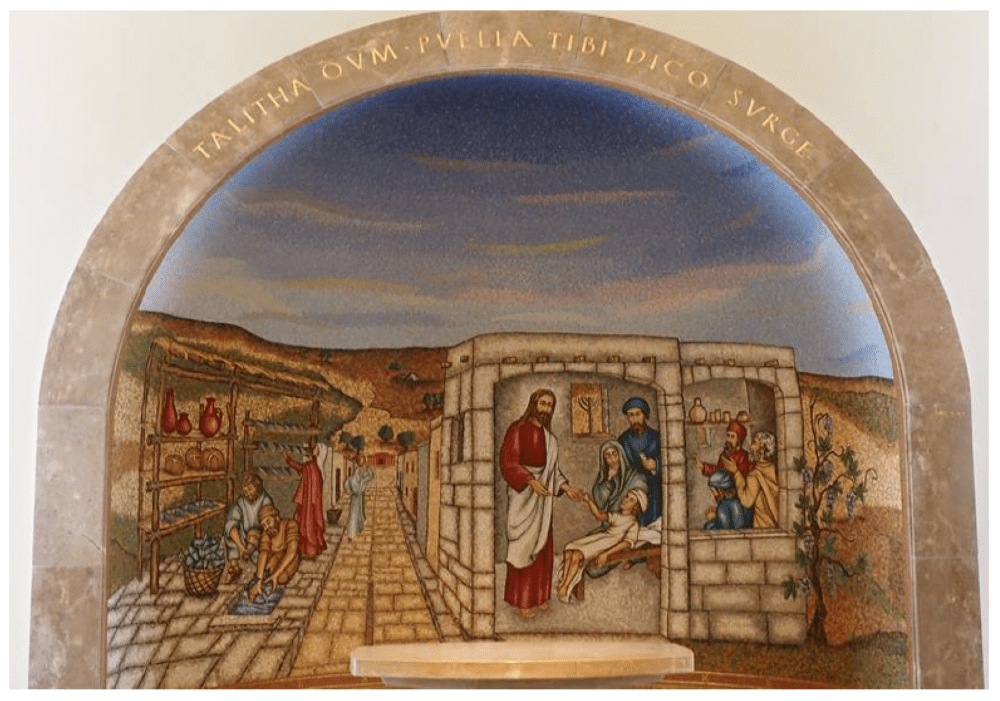
Talitha qum (Daughter of Jairus), Northwest Chapel, Duc in Altum (Magdala)
 Words of Grace