
I have recently finished reading a number of books and pamphlets and the thought of writing several full-length reviews has become too daunting. I know myself and recognize that if I don’t write something short, then I won’t write anything at all about these works. So, in the interest of “something is better than nothing,” here are some blurbs on those books with brief recommendations or encouragements to avoidance:
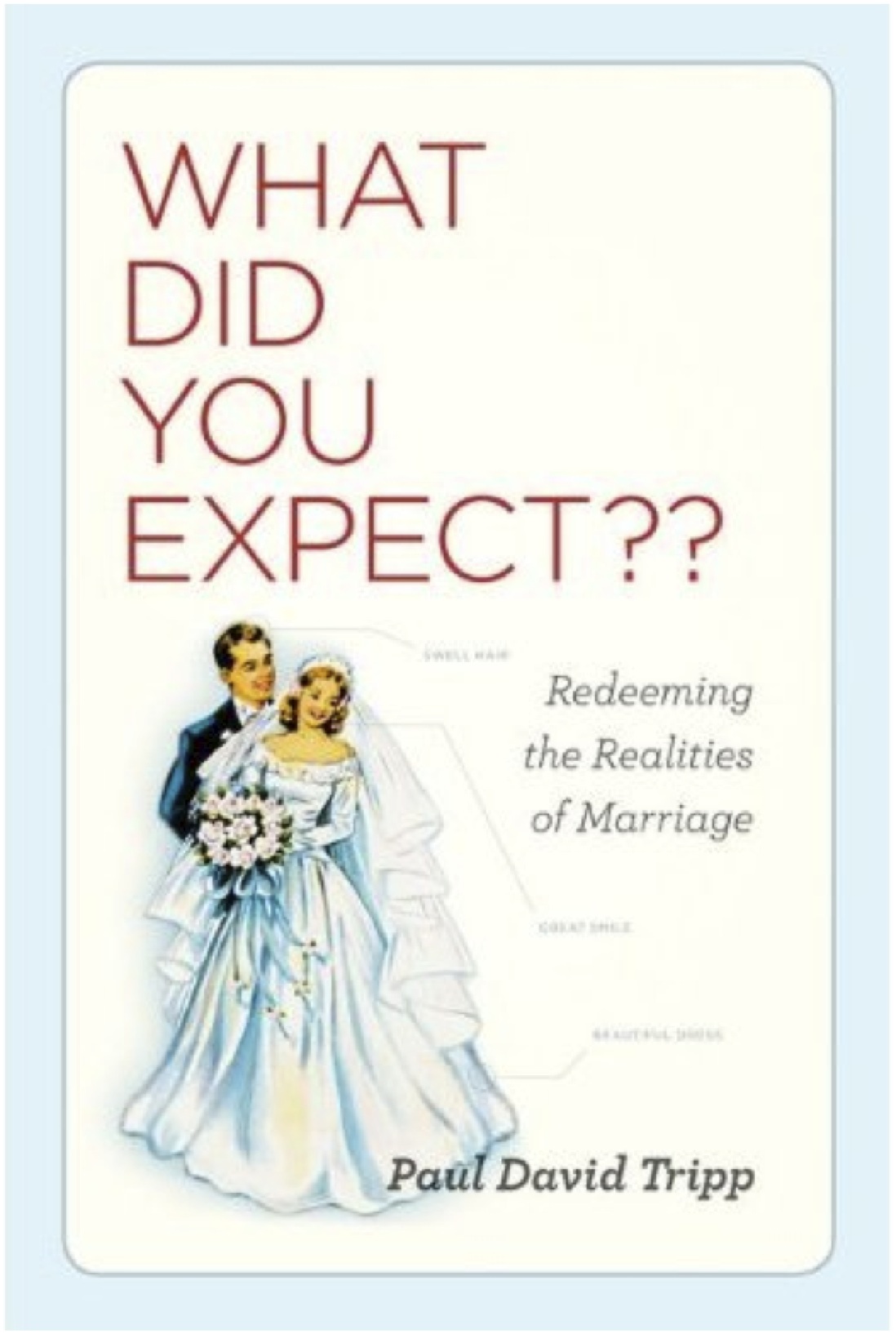 Title: What Did You Expect? Redeeming the Realities of Marriage
Author: Paul Tripp
Publisher: Crossway, 2010; 288 pp. $21.99 ($7.99 as an ebook)
Recommendation (4-star scale): 
This is now one of my two favorite books on marriage (see also, This Momentary Marriage). His emphasis on understanding the problems of marriage as God’s grace to produce change in one’s life (though not necessarily in one’s mate) is a message that needs to be heard and emphasized over and over.
Representative quote:
God is never surprised at the obstacles you encounter as you live with your husband or wife. He planned for you to be married to a flawed person and for you to live in a fallen world together. He intended marital hardship to drive you to his grace and, as it does, to cause you to grow and mature together.
To accomplish this, Tripp writes this book around six commitments that each marriage partner should make:
COMMITMENT 1: We will give ourselves to a regular lifestyle of confession and forgiveness.
COMMITMENT 2: We will make growth and change our daily agenda.
COMMITMENT 3: We will work together to build a sturdy bond of trust.
COMMITMENT 4: We will commit to building a relationship of love.
COMMITMENT 5: We will deal with our differences with appreciation and grace.
COMMITMENT 6: We will work to protect our marriage.
Read this book if you are married and want godly wisdom to be a more godly mate to your spouse.

 Title: Duties of Parents
Author: J. C. Ryle
Publisher: Triangle Press, 1993 (Reprint); 38 pp. $2.50 ($0.99 as an ebook); the text of this book is also readily available for free on the Internet, including here.
Recommendation (4-star scale):
Short. Concise. Old. And still very helpful. This brief work covers 17 different topics, including things like a child’s knowledge of the Bible, cultivating a habits of prayer, corporate worship, faith, obedience, and truthfulness in your children, and parenting with a remembrance of how God trains His children.
This book is very quotable and easily accessible. It’s short chapters serve as brief guides and timely reminders that can be read repeatedly even in one day.
Representative quotes:
This is the thought that should be uppermost on your mind in all you do for your children. In every step you take about them, in every plan, and scheme, and arrangement that concerns them, do not leave out that mighty question, “How will this affect their souls?”
Love is one grand secret of successful training. Anger and harshness may frighten, but they will not persuade the child that you are right; and if he sees you often out of temper, you will soon cease to have his respect.
Train them remembering continually the influence of your own example. Instruction, and advice, and commands will profit little, unless they are backed up by the pattern of your own life. Your children will never believe you are in earnest, and really wish them to obey you, so long as your actions contradict your counsel.
Read this book if you need some concise and timely parenting advice.
 Title: Crazy Love: Overwhelmed by a Relentless God
Author: Francis Chan
Publisher: David C. Cook, 2008; 192 pp. $14.99 ($5.20 as an ebook)
Recommendation (4-star scale): 
Francis Chan was a pastor in Simi Valley, CA, before resigning quite unexpectedly earlier this year. He is now apparently looking to move to Southeast Asia to begin a new ministry there. His books are very popular and I read this one not because I was particularly interested in it, but because I wanted to see what other believers are reading.
His premise is that too many believers are stuck in a state of lukewarmness because they are attempting to serve God out of duty instead of a passionate love of Christ: “This book is written for those who want more Jesus. It is for those who are bored with what American Christianity offers. It is for those who don’t want to plateau, those who would rather die before their convictions do.”
On one hand, I appreciate his desires and found that I was less critical and more appreciative of the book than I had anticipated. His sections on those who are lukewarm are very helpful and encouragingly convicting. However, there is a tone of “give all your stuff away to social causes and those who are needy because you will reap heavenly reward” that fails on two counts: it seems to emphasize social needs over evangelistic purposes and his biblical justification and explanation also is weak as I believe he misuses and misapplies some Old Testament passages.
Overall, I didn’t dislike the book (somewhat of a surprise to me), but I also think there are some better books that deal with the same themes of weak-faithed believers in a more biblical fashion (e.g., several books each by John Piper, John MacArthur, and Jerry Bridges).
Representative quotes:
When we work for Christ out of obligation, it feels like work. But when we truly love Christ, our work is a manifestation of that love, and it feels like love.…
Q. Do you think God calls you to live a radical, crazy life?
A: It’s not that this lifestyle should be crazy to us. It should be the only thing that makes sense. Giving up everything and sacrificing everything we can for the afterlife is logical. “Crazy” is living a safe life and storing up things while trying to enjoy our time on earth, knowing that any millisecond God could take your life. To me that is crazy, and that is radical. The crazy ones are the ones who live life like there is no God. To me that is insanity.
Read this book if you want to read what many other Christians are reading and if you want to be challenged about your weak faith.
 Title: Speaking the Truth in Love
Author: David Powlison
Publisher: New Growth Press, 2005; 205 pp. $17.99
Recommendation (4-star scale):
Yes, this is a book about counseling. But it’s more than that. It’s a book about being intentional in instilling godly discipleship into all our relationships. So, while this book will be of obvious benefit to those who are actively engaged in counseling others, it really is a book to teach every believer to be more proactive in building godly friendships.
The book is divided into two sections —the first discusses how to engage in fruitful two-way conversations. For example, how can we help people see themselves more clearly? And relating the gospel to the difficult circumstances of life. And identifying what kind of questions help people move to uncovering the deeper problems of their lives.
The second section is about what the church does to counsel and minister to those in need. For example, what does it mean to “minister the Word” to others? And, how do pastors counsel in the context of the church and how to women counsel and how does that influence counseling in the church? And, should counselors in the church ever refer counselees to others?
Representative quotes:
Wise counseling is essentially a way of loving another person well. It is a way of speaking what is true and constructive into this person’s life right now. Good counseling is essentially love in action.
How do you learn to see straight and think straight, when something inside you compulsively bends in the wrong direction? You need a clear-eyed realism about the human tendency towards self-blinding. Only then will you bring a buoyant sense of the centrality of the grace of Jesus Christ in counseling ministry. And only then will you help people make the most essential change of all, learning to know God in real life.
Read this book if you want to increase your skills as a counselor or you want to learn to be someone who intentionally cultivates discipleship into all your relationships and friendships.
 Title: If God is God, Why Do We Hurt? (This pamphlet is an excerpt of the longer book, If God Is Good: Faith in the Midst of Suffering and Evil.)
Author: Randy Alcorn
Publisher: Multnomah Books, 2010; 64 pp. $1.99 ($1.59 as an ebook)
Recommendation (4-star scale):
The questions of theodicy — how can God be righteous and there be suffering in the world — have long been asked (starting with the oldest book in the Bible, Job). Here is another very helpful and brief set of answers to that question. If the full-length book is as helpful as this pamphlet, then it will be a very good addition to your library.
Representative quotes:
God isn’t the author of evil, but he is the author of a story that includes evil. He intended from the beginning to permit evil, then to turn it on its head — to take what fallen angels and fallen people intended for evil and use it for good. In the face of the worst wrongs, God intended to show his highest good.…
Suffering reminds us of life’s brevity and our closing window of opportunity to get right with our Creator and trust him in ways we are not prone to do when life is smooth and easy.…
So yes, this hurting world has truckloads of evil. But it also has boatloads of good. Where did all that goodness come from? If you argue that evil is evidence against God’s existence, you must also admit that good is evidence that God does exist.…
What we call the problem of evil is often the problem of our finite and fallen understanding. We assume God should answer our questions, but sometimes our questions can’t be answered. We’re like children who can’t fathom why their parents won’t let them stay up late, eat cookies for dinner, or feed chocolate to the dog. They don’t comprehend why we discipline them, make them clean their rooms, or take them to the dentist. One day, when they grow up, they’ll get it. And so will we.
Read this book if you have ever wrestled with the question of evil and suffering.
 Words of Grace