
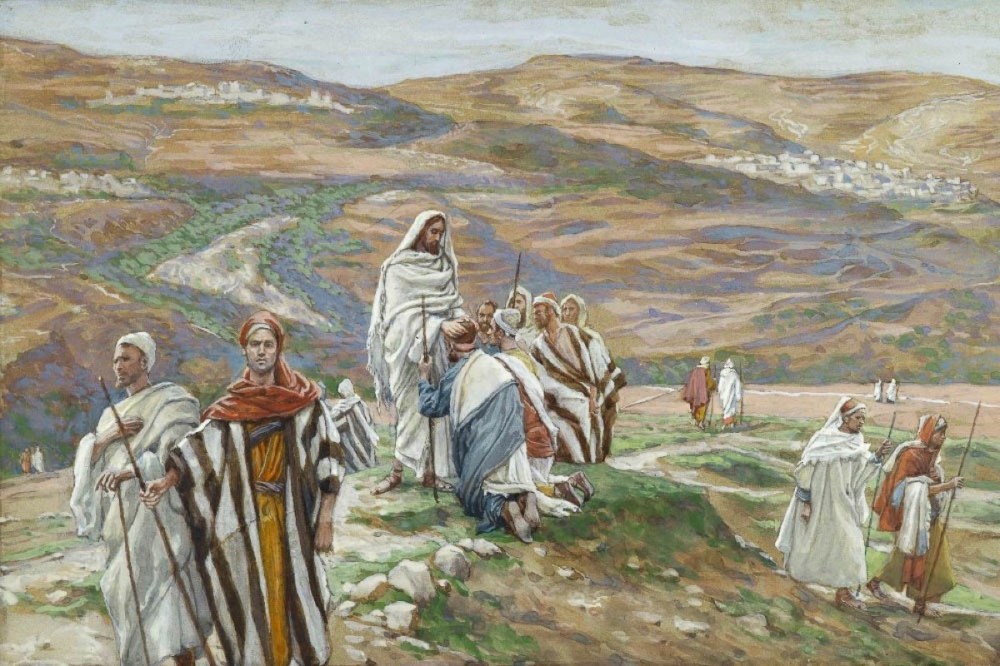
“Sent with the Gospel”
Luke 10:1-16
May 17, 2026
In 1786 a man named William was ordained for the pastorate and sent to a small church in the town of Moulton, England. Both he and the church were very poor, and it took three jobs for William to support his family: pastor, cobbler, and village teacher.
In his cobbler’s workshop, William made a large homemade map of the world and began collecting data on the world’s population. This data was compiled into an 87-page book in 1791: An Enquiry into the Obligations of Christians to use Means for the Conversion of Heathens, in which the religious state of the different nations of the world, the success of former undertakings, and the practicability of further undertakings, are considered. This “‘little piece,’ as William called it, would become the manifesto of the modern missionary movement.” The man, of course, is William Carey and his passion for the salvation of the lost is seen throughout the document, but perhaps most boldly in his statement, “I question whether all are justified in staying here, while so many are perishing without means of grace in other lands.”
On May 31, 1792, Carey was asked to speak to a group of pastors from an association of 24 churches. He chose as his text Isaiah 54:2-3 and in that sermon he uttered words that have stimulated the missions movement for the next 2-½ centuries: “Expect great things; attempt great things.” His meaning is clear — God is the provider of all and many great things, and on the basis of God’s provision, the believer is to attempt similarly great things that will bring honor and glory to the name of God.
Less than a year later, Carey and John Thomas and their families were on their way to India with the gospel. All of them would die in India, never returning to England; Carey died 41 years later.
What was the result of Carey’s ministry in India? He either translated or directly oversaw and edited 41 partial or complete translations of the Bible. He was instrumental in the planting of Lall Bazar Chapel in Calcutta in 1809 — a church that continues in ministry to this day, now under the name Carey Baptist Church. During his ministry they oversaw the opening of over 100 schools for the Biblical education of Indians. The man who had an elementary education was given a doctorate in linguistics and served as a Department Chairman of the Fort William College in Calcutta for 30 years (from 1801 until 1830). He also was instrumental in the abolition of infanticide, abortion, slavery and sati in India. And by the time of his death in 1834, there were 50 missionaries serving in 18 mission stations in India.
Carey was a simple, common man who was used by God for remarkable purposes. His life was marked by the simple statement made that sermon in 1792: “expect great things; attempt great things.”
The question of who will go and serve God in ministry is an old one. Think about Abraham, Moses, Elijah, Elisha, Isaiah, Jeremiah, Ezekiel, Daniel, and the rest of the prophets. And the Twelve apostles (“sent ones”), and Paul and Barnabas. And the 72 followers of Christ, which is the account from Luke in front of us today (Lk. 10:1-16).
As we come to this passage we need to recognize that this was a unique event; the instructions and commissioning in this passage are for the 72 on that event. It was a one-time commissioning. However, the principles that Jesus gave in sending the 72 are fitting for us as well, as we think about ministry, missions, evangelism, and building the church. This passage immediately follows the narrative of three almost-followers of Christ; it serves as a contrast, and it also gives us a picture of what it means to follow Christ. What did Jesus command the 72 to do and how did they demonstrate that they were following Christ?
To follow Christ, serve Christ.
In this passage we learn how to follow Christ by carrying out six responsibilities of serving Christ. The principles in this passage guide us as we think about missions and sending William and Natalyn overseas; it informs how we think about evangelizing our community, and it directs how we plan for the ministry of this church and use the gifted people God has given us.
- Serve Christ by Submitting to His Authority (vv. 1-2)
- Serve Christ by Conforming Your Expectations (v. 3)
- Serve Christ by Recognizing the Urgency (v. 4)
- Serve Christ by Trusting His Provision (vv. 5-8)
- Serve Christ by Doing His Work (vv. 9-12)
- Serve Christ by Declaring His Warning (vv. 13-16)
Download the rest of this sermon on Luke 10:1-16.
James Tissot, “He Sent them out Two by Two,” public domain.
The audio will be posted on the GBC website by Tuesday.


_-_James_Tissot_-_overall.jpg)